


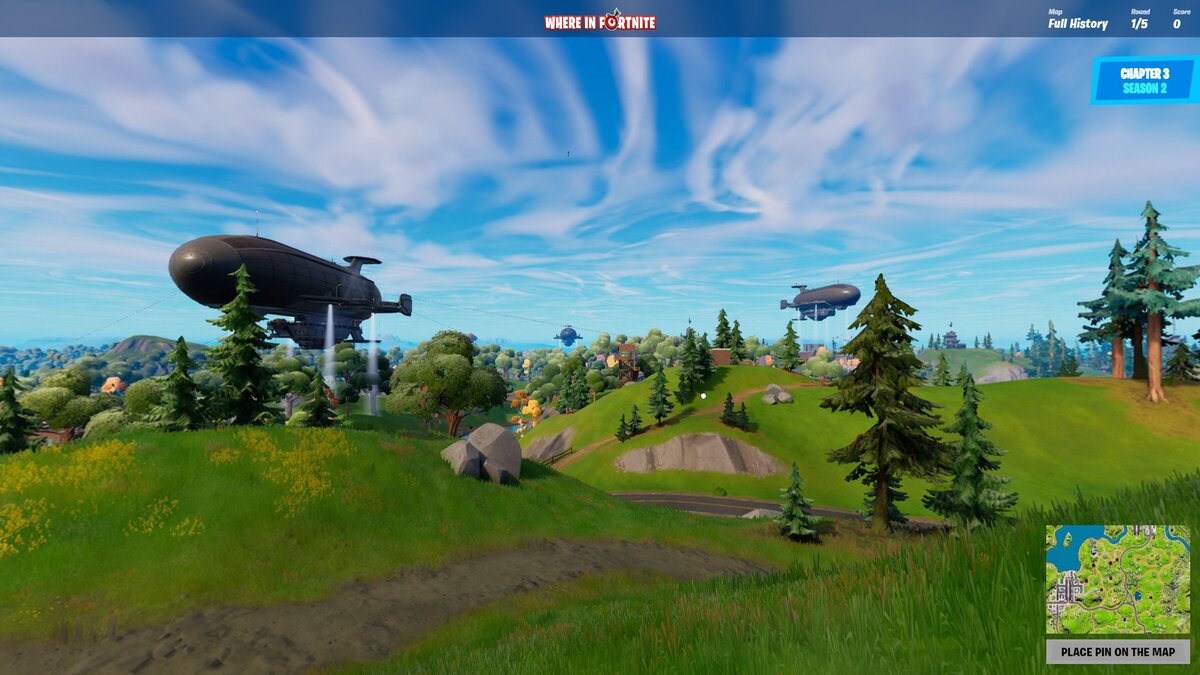
Fortnite GeoGuessr is a location guessing game that drops players into static images or 3D environments across historical Fortnite maps to pinpoint their exact location. You can play directly inside Fortnite using island code 4749-0459-3824 or through browser platforms like Lostgamer.io and Where in Fortnite.
How to Launch Fortnite GeoGuessr Across Platforms
Executing Fortnite GeoGuessr requires following specific interface paths depending on whether you choose a native Creative island or a web browser format.
Native UEFN Creative Client Path
- Open the Fortnite game client and navigate to the Discover tab.
- Select the search bar and enter island code 4749-0459-3824 to load Fortnite GeoGuessr OG Edition.
- Spawn into the lobby room and observe the 360-degree panoramic skybox view.
- Complete the optional lobby parkour jumps between rounds to gain point multiplier boosts.
- Equip any weapon, align your crosshairs with your target location on the interactive coordinate grid wall, and fire to register your guess.
Lostgamer Browser Path
- Navigate to lostgamer.io in your web browser.
- Choose Singleplayer for solo leaderboard runs, Multiplayer for custom rooms with up to 100 players, or Raids to fight AI bosses.
- Select your map era from 25 available historical chapters and seasons.
- Set round counts to 5 and round timers to 60 seconds for standard competitive play.
- Rotate the ground view camera, open the 2D map overlay, drop your pin, and submit before time expires.
Where in Fortnite Browser Path
- Access the Where in Fortnite web client.
- Select your desired chapter and season map.
- Adjust camera pan constraints and round timers based on your practice preferences.
- Enable Night Mode if you want to test acoustic and silhouette recognition skills.
- Review the static panorama and drop a marker on the mini map overlay to finalize your score.
Platform System Requirements and Settings
System preparation depends on whether you play inside the native Unreal Engine environment or through web apps. Playing native Creative mode requires adjusting your optimal Fortnite keybinds and settings to ensure quick weapon firing and smooth crosshair positioning.
| Operational Parameter | Web Browsers | UEFN Creative Client |
|---|---|---|
| Access Method | Web Browser with WebGL | Fortnite Client via Epic Games |
| Map Code or URL | lostgamer.io or Where in Fortnite | Island Code 4749-0459-3824 |
| Account Requirements | None for guest play; Free account for leaderboards | Valid Epic Games account |
| Input Hardware | Mouse and Keyboard or Touchscreen | Controller or Mouse and Keyboard |
| Score Submission | Pin placement on 2D map overlay | Weapon fire raycast against grid wall |
Spatial Telemetry and Distance Calculations
Scoring mechanics differ based on platform architecture. Web platforms like Lostgamer use Gaussian decay functions to compute points based on Euclidean distance x in meters:
S = S(max) x exp(-0.5 x (x / sigma)^2)
In this equation, S(max) represents the scoring ceiling of 2,500 or 5,000 points, while sigma is the map scale constant derived from user-defined limits:
sigma² = -s² / (2 x ln(d(decay)))
Traditional web systems using spherical Haversine models apply an exponential curve where error distance d and total map diagonal D determine final score S:
S = 5000 x e^(-10d / D)
Inside native UEFN Creative maps, custom Verse scripts calculate horizontal distance server-side. To ensure vertical elevation does not penalize guesses on mountains or tall buildings, the script ignores Z-axis altitude values entirely. The flat two-dimensional distance d(2D) converts Unreal Units directly to meters using a basic conversion formula:
d(2D) = floor( sqrt((X(guess) – X(target))² + (Y(guess) – Y(target))²) / 100 )
Engine physics rely on fixed metric constants. 1 Unreal Unit equals exactly 1 centimeter. A standard modular wall measures 384 UU in height (3.84 meters) and 24 UU in thickness (24 centimeters). Standard mini map grid squares span 25,000 UU (250 meters). With player sprinting speeds fixed at 550 UU per second (5.5 meters/second), crossing a single grid square on foot takes T = 250 / 5.5 = 45.45 seconds.
Environmental Landmarks and Orientation Rules
When dropped into featureless fields without structural landmarks, environmental engine rules reveal your position.
- Solar Azimuth: The sun moves from East to West. Dawn and dusk produce an orange tint on the horizon that establishes true North.
- Skybox Cloud Motion: Skybox cloud textures drift continuously from West to East across all maps.
- River Current Direction: Standard rivers flow outward from high central mountains to the ocean. In the Southeastern quadrant of Chapter 1, river currents move inward toward the center of the map. Water flowing inland immediately confirms you are in the Southeastern quadrant.
Historical Epochs and Seasonal Identification
Identifying past battle royale map iterations requires matching structural assets, flora, and mobility items against specific timeline eras.
- Chapter 6 Season 1: Marked by Japanese shrines, wide plains, cherry blossom trees, and the Giant Turtle location.
- Chapter 7 Season 1: Features Red-Rock Canyons, coastal deserts, Wonkeeland, Sandy Strip, Wingsuits, and Wave Launchers.
- Chapter 7 Season 3: Identifiable by glowing Sprites (Water, Earth, Fire, and Zero Point) attached to players, the King Sprite boss, and Bubble Shield Jr items.
- OG Season 9: Features classic Chapter 1 terrain alongside melting snow at Polar Peak that reveals the skeletal body of the Devourer Kaiju.
Common Failure Points and Player Errors
- The Altitude Displacement Trap: Players often miscalculate horizontal distances in mountainous areas like Classified Canyon or Polar Peak. In UEFN Creative maps, adjusting horizontal pin placement to account for mountain height causes errors because the engine ignores altitude completely.
- API Shadowbans and Network Limits: Browser backends send coordinate data via background requests protected by authentication tokens. Automated tools or scripts that attempt to read coordinate payloads trigger API rate limits, resulting in shadowbans that return undefined coordinate values and score zero points.
- Texture Homogeneity: Agricultural zones like Frenzy Farm and open grasslands look visually identical. High-level players rely on soil crop row vectors, fence variations, and mountain silhouettes along the horizon rather than ground textures.
- Interface Lockout Bugs: Rapidly dragging the web overlay map can cause the browser window to lose focus, preventing guesses before the timer runs out. In UEFN mode, standing too close to the interactive coordinate wall can cause weapon shots to miss raycast detection.







Updated: Jul 31, 2026 12:12 pm