Forgot password
Enter the email address you used when you joined and we'll send you instructions to reset your password.
If you used Apple or Google to create your account, this process will create a password for your existing account.
This site is protected by reCAPTCHA and the Google Privacy Policy and Terms of Service apply.
Reset password instructions sent. If you have an account with us, you will receive an email within a few minutes.
Something went wrong. Try again or contact support if the problem persists.
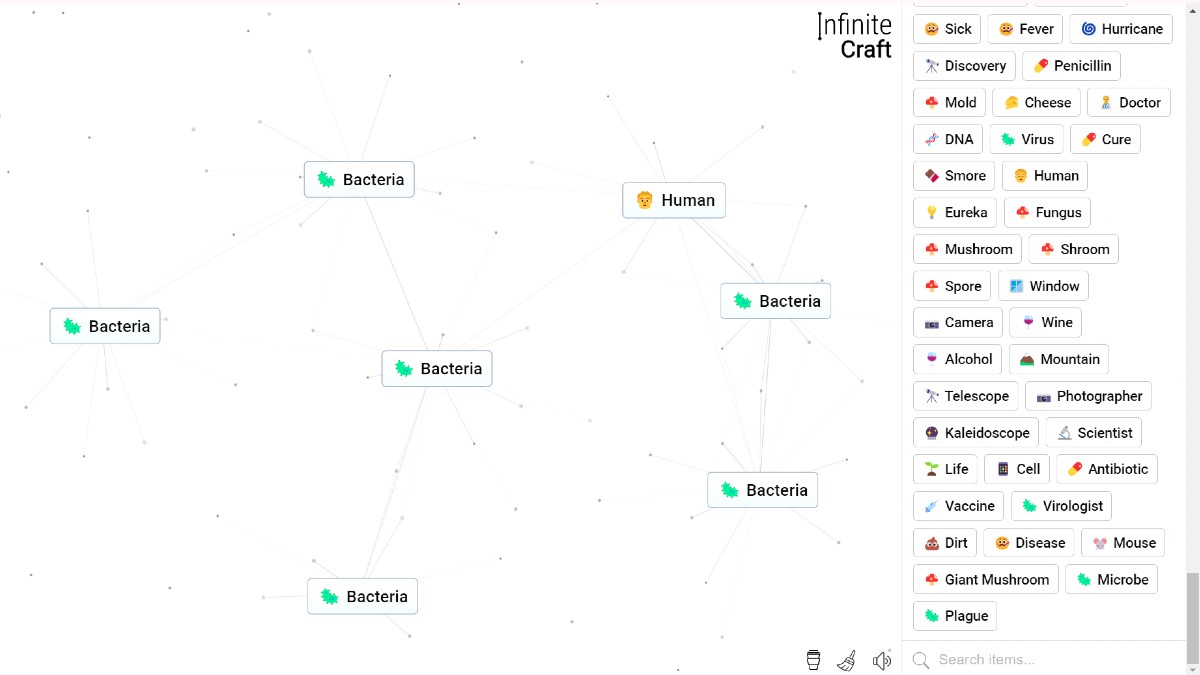
The human block in Infinite Craft.
Image Source: Neal.Fun via Twinfinite

How to Make Human in Infinite Craft: The Ultimate Crafting Recipes and Shortcuts

Back to basics!

To make a Human in Infinite Craft, you must combine the Life element with the Earth element. If you are starting from scratch on a clean board, the fastest route is to merge Earth and Wind into Dust, evolve Dust and Planet into Mars, craft Life, and then add Earth to complete humanity.

Recommended Videos

My Obsession with Neal Agarwal’s Sandbox and Why You Need Humans First

When I first opened the blank canvas of Infinite Craft on my browser, I spent hours dragging classical elements across the screen, getting lost in a sea of nonsensical combinations. Like most players, I quickly realized that the game remains a simple geological simulator until you unlock the Human element.

Unlocking humanity is the ultimate gateway block. Once you have a Human on your board, you transition from simple natural structures into the realms of history, culture, professions, and hilarious pop-culture references.

Many early guides recommended a highly convoluted biological pathway to reach this milestone. That outdated route forced players to craft Glass, combine it with Fire to make a Lens, mix the Lens with Water to construct a Microscope, drag the Microscope onto Mud to generate Bacteria, and finally mix Bacteria with Steam to spark Life. That ten-step microscope path is an absolute waste of time and space. By leveraging cosmic mechanics instead of microbiology, you can unlock humanity in just a few clicks.

The Master Key: Navigating the Canvas and Finding the Perfect Sorting Meta

Before we jump into the exact recipes and all crafting combinations, let us get comfortable with the interface. When you load up the game, you are looking at an expansive HTML5 canvas.

  • Dragging and Dropping: You drag elements from the right-hand sidebar onto the blank canvas workspace. When you bring two element cards within 30 pixels of each other, a thin proximity line will appear to show they are ready to merge. Overlap them completely and they will trigger an API call to synthesize your new block.
  • Clearing the Slate: As your workspace gets cluttered with duplicate blocks, click the sweep broom icon in the bottom-left corner of your screen to clear your active canvas without losing your hard-earned progress.
  • Sidebar Sorting and Search: Use the sorting toggle on the bottom right to sort your unlocked elements alphabetically or chronologically. When you are deep into a complex crafting chain, use the search bar in the bottom-right corner of the sidebar to instantly find Life or Earth without endlessly scrolling.

The Absolute Fastest Path to Create Human in Six Quick Steps

This is the fastest, cleanest, and most popular method used by the speedrunning community. It requires only six steps from a completely fresh board, bypassing all complex atmospheric and biological chains.

  1. Combine Earth and Wind to create Dust.
  2. Combine Dust and Wind to create Sandstorm.
  3. Combine Earth and Dust to create Planet.
  4. Combine Planet and Sandstorm to create Mars.
  5. Combine Mars and Earth to create Life.
  6. Combine Life and Earth to create Human.

This cosmic route is incredibly elegant because it utilizes the planetary scale of the backend engine to spark life directly from the red planet, saving you from navigating nested sub-elements.

The Biblical Alternative: How to Craft Adam and Eve from Scratch

If you prefer a more traditional, narrative-driven route, you can follow the theological creation path. This ten-step method allows you to craft the biblical progenitors of the human race and merge them to form humanity.

  1. Combine Fire and Wind to create Smoke.
  2. Combine Smoke and Water to create Fog.
  3. Combine Earth and Wind to create Dust.
  4. Combine Dust and Earth to create Planet.
  5. Combine Planet and Fog to create Venus.
  6. Combine Water and Fire to create Steam.
  7. Combine Earth and Steam to create Mud.
  8. Combine Venus and Mud to create Adam.
  9. Combine Adam and Venus to create Eve.
  10. Combine Adam and Eve to create Human.

This path is highly favored by players who love the metaphorical logic of the game, creating the goddess of love from fog and planetary dust, then forming man from the mud.

The Biological Path: Tracing Evolution from Plant to Primate

For the science lovers out there, you can take a scenic evolutionary route. This method takes a bit longer but populates your sidebar with highly useful botanical and zoological building blocks along the way.

  1. Combine Water and Fire to create Steam.
  2. Combine Steam and Earth to create Plant.
  3. Combine Plant and Water to create Algae.
  4. Combine Algae and Earth to create Life.
  5. Combine Earth and Fire to create Lava.
  6. Combine Lava and Water to create Stone.
  7. Combine Stone and Life to create Egg.
  8. Combine Egg and Life to create Bird.
  9. Combine Plant and Plant to create Tree.
  10. Combine Tree and Tree to create Forest.
  11. Combine Forest and Forest to create Jungle.
  12. Combine Bird and Jungle to create Monkey.
  13. Combine Life and Monkey to create Human.

The Math and Backend Magic Driving Your Infinite Discoveries

Have you ever wondered why some elements combine so beautifully while others fail completely? The answer lies in the brilliant backend design of the game.

Mathematically, the combination space of Infinite Craft can be modeled as a Commutative Magma. In abstract algebra, a magma is a basic algebraic structure consisting of a set equipped with a closed binary operation. Because the game’s client-side code automatically sorts your input elements alphabetically before sending them to the database, the operation is strictly commutative: a + b = b + a for all elements a and b in the set. However, the binary operator is explicitly non-associative: (a + b) + c does not always equal a + (b + c).

We can prove this non-associative nature using three of the starting elements. Combining Water and Earth yields Plant, so (Water + Earth) + Fire = Plant + Fire = Smoke. However, combining Earth and Fire yields Lava, so Water + (Earth + Fire) = Water + Lava = Stone. Because Smoke does not equal Stone, associativity fails. This is why standard greedy algorithms cannot easily find the shortest path to a target element — the system behaves more like a complex addition chain where early choices dictate downstream efficiency.

From an infrastructure perspective, the server-side architecture is powered by Facebook’s open-weights Llama models, hosted on Together AI. When you attempt a combination that has never been tried before, the backend executes a live LLM prompt asking what element was produced by combining the two inputs. Together AI charges approximately $0.20 per one million tokens. With a typical structured prompt of 88 tokens, a single un-cached generation costs roughly $0.0000176.

To prevent this from becoming financially unsustainable during peak hours when thousands of players are crafting simultaneously, Neal implemented an in-memory Redis database cache. If a player inputs a combination that has already been discovered, the server pulls the result instantly from the database, achieving a cache hit rate of over 85%. This caching layer ensures that combinations are deterministic and identical for every player across the globe. Additionally, the backend implements a strict safety cap — elements are restricted to a maximum of 20 Llama tokens, with each token limited to 16 characters, setting a physical database limit of 320 characters to prevent malicious script injection.

Where Do We Go from Here? Unleashing Humanity on the Sandbox

Now that you have unlocked the Human block, you hold the key to the most entertaining combinations in the game. With the recent server-side Llama 3.1 patch, the model has become incredibly precise at associating modern pop culture, memes, and complex philosophical themes. Here are a few combinations to get you started:

  • Human + Spider = Spider-Man
  • Human + Human = Love
  • Human + Love = Family
  • Human + Robot = Singularity

Keep dragging, keep combining, and watch out for those elusive First Discoveries as you build your custom universe!


Twinfinite is supported by our audience. When you purchase through links on our site, we may earn a small affiliate commission. Learn more about our Affiliate Policy
Explore the GAMURS Network
Author
Image of Jorge Aguilar
Jorge Aguilar
Aggy has worked for multiple sites as a writer and editor, and has been a managing editor for sites that have dozens of millions of views a month. He's been the Lead of Social Content for a site garnering millions of views a month, and co owns multiple successful social media channels, including a Gaming news TikTok, and a Facebook Fortnite page with over 700k followers. His work includes Dot Esports, Screen Rant, How To Geek Try Hard Guides, PC Invasion, Pro Game Guides, Android Police, N4G, WePC, Sportskeeda, and GFinity Esports. He has also published two games under Tales and is currently working on one with Choice of Games. He has written and illustrated a number of books, including for children, and has a comic under his belt.
Author
Image of Luke Hinton
Luke Hinton
Luke Hinton is a video games journalist currently working as Senior Guides Writer and Associate Editor at Twinfinite. He has undergraduate and postgraduate degrees in Journalism, Media, and Culture, and previously specialised in entertainment writing.