Forgot password
Enter the email address you used when you joined and we'll send you instructions to reset your password.
If you used Apple or Google to create your account, this process will create a password for your existing account.
This site is protected by reCAPTCHA and the Google Privacy Policy and Terms of Service apply.
Reset password instructions sent. If you have an account with us, you will receive an email within a few minutes.
Something went wrong. Try again or contact support if the problem persists.
minecraft netherite

Minecraft Netherite Guide: How to Get Netherite Armor, Tools, Spears, and Horse Armor

This is how you become the strongest.

If you are still running around your survival world clad in plain old diamond gear, you are leaving a massive amount of power on the table. When Mojang released the Nether Update, diamond officially lost its crown. However, with the massive version 1.20 template overhaul and the recent Mounts of Mayhem update (released as Java Edition 1.21.11 and Bedrock Edition 1.21.130), getting your hands on this dark, fireproof metal is more complex than ever.

Recommended Videos

I spent my first hours in the Nether mining blindly at random coordinates, only to end up with a lava-charred pickaxe and an inventory full of useless netherrack. That is why I wrote this guide. I will walk you through exactly how to farm, refine, and craft a full set of Netherite gear, including the brand-new Netherite Spear and Netherite Horse Armor, so you can dominate your next hardcore playthrough or survival server.

The Spatial Mathematics of Finding Ancient Debris

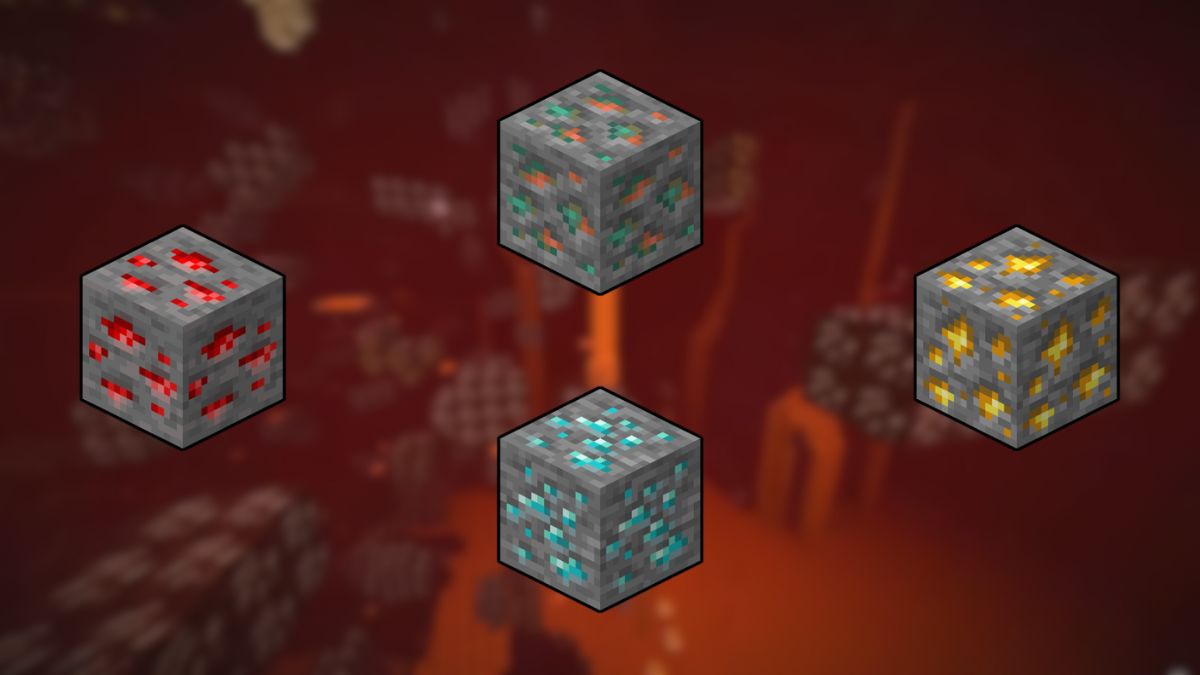
how to get netherite armor in minecraft, minecraft ancient debris
Ancient Debris in the Nether | Image Credit: u/RRhinoG

The game’s terrain generation engine runs on strict mathematical algorithms. Ancient debris never generates naturally exposed to air; it will only replace solid netherrack, basalt, and blackstone.

The mathematical difference between how the game populates chunks in Java and Bedrock breaks down like this:

  • Java Edition Chunk Rules: The engine attempts to generate up to two separate clusters per chunk.
    • Cluster One: 0 to 3 blocks of ancient debris placed using a triangular distribution between Y=8 and Y=24. The probability curve peaks at Y=15, making it the mathematical sweet spot.
    • Cluster Two: 0 to 2 blocks of ancient debris placed uniformly from Y=6 all the way to Y=119.
  • Bedrock Edition Chunk Rules: The engine executes up to five separate generation passes per chunk.
    • Clusters One and Two: Two separate groups of 0 to 3 blocks placed with a triangular distribution between Y=8 and Y=24.
    • Clusters Three, Four, and Five: Three smaller groups of 0 to 2 blocks spread uniformly from Y=6 to Y=119.
  • The Probability Formula: A single chunk consists of a 16×16 grid spanning 256 blocks horizontally. In Java Edition, there is a mean density of 1.65 ancient debris blocks per chunk. If we isolate the primary mining volume from Y=6 to Y=121 (which is 115 blocks tall), we have exactly 29,440 blocks in that vertical chunk slice. The mathematical probability P of any single block being ancient debris is: P = 1.65 / (16 x 16 x 115), which equals approximately 0.0056%. If we look at the entire chunk volume (16 x 16 x 128), the chance drops to approximately 0.004% per block.
  • Maximum Vein Limits: Because the generation engine runs independent checks, it is technically possible for adjacent chunks to generate their maximum clusters right on their shared borders. If a maximum cluster of five blocks spawns in the touching corners of four adjacent chunks, you can find a contiguous vein of up to 20 ancient debris blocks.

Mining ROI: The Battle of Bed Explosions versus TNT Tunnels

Before you head out with your pickaxe, you need to decide on an extraction strategy. Here is the breakdown of the prevailing community mining metas based on rigorous in-game speed tests:

  • TNT Mining along Chunk Borders (ROI: ~89 Debris per Hour): This is by far the fastest and cleanest method, but it is highly resource-heavy. You need to set up a gunpowder farm and shovel stacks of sand to craft about seven stacks of TNT per hour of mining.
  • 2×2 Strip Mining along Chunk Borders (ROI: ~39 Debris per Hour): This method is completely sustainable and requires almost zero setup. Use a Diamond Pickaxe enchanted with Efficiency II (or higher), Unbreaking III, and Mending. Netherrack has a hardness of 0.4, so Efficiency II allows you to break it instantly. This means you can mine at a speed of roughly 12 blocks per second while maintaining a continuous sprint. The experience you collect from mining Nether Quartz and Nether Gold Ore automatically repairs your pickaxe via the Mending loop, requiring only a food supply.
  • Bed Mining along Chunk Borders (ROI: ~37 Debris per Hour): This is the ultimate early-game budget method. Beds explode with an explosion power of 5 in the Nether, which is higher than TNT (which has a power of 4). Because ancient debris has a blast resistance of 1,200, the explosion vaporizes the surrounding netherrack while leaving the debris untouched. The biggest drawback is inventory space; beds do not stack. Bring a Shulker Box filled with raw logs and wool to craft them on-site.

How to Set Up Bed Explosions Safely

  • Mine a main branch tunnel at Y=15.
  • Every 16th block, dig a perpendicular 1x1x5 side tunnel at eye level.
  • Place a bed at the very end of this side tunnel.
  • Stand exactly 6 blocks away to stay completely out of the bed’s lethal blast radius.
  • Break the block below you and place a stone slab. Crouching behind this slab block protects your lower hitbox, allowing you to trigger the bed explosion with zero blast damage.
  • Always drink a potion of fire resistance before starting.

The Chunk Border Optimization Trick

  • Pressing F3 + G on your keyboard reveals the yellow and red bounding lines of game chunks.
  • Because the generation engine limits the number of debris clusters per individual chunk (a maximum of two in Java), mining exactly on the seam between Chunk A and Chunk B allows you to visually inspect blocks from both chunks at once.
  • Once you find a cluster on the Chunk A side of your tunnel, the mathematical probability of finding another cluster in that same chunk drops to zero. You can then quickly move further down the border to focus your mining efforts on fresh, unmined chunks.

How to Get the Netherite Upgrade Smithing Template for Free in Minecraft

In Minecraft version 1.20, Mojang completely overhauled the progression system by introducing the Netherite Upgrade Smithing Template. This template is consumed every single time you upgrade a piece of diamond gear.

To get your first template, you must raid a Bastion Remnant. Here are the exact loot drop rates across the different bastion chest types:

Chest TypeTemplate Spawn Rate
Treasure Room Chest100% (guaranteed)
Generic Chests10%
Hoglin Stable Chests10%
Bridge Chests10%

To safely clear these structures, always wear at least one piece of gold armor (like gold boots) to keep the standard Piglins neutral. However, watch out for Piglin Brutes. They have 50 health points, wield devastating golden axes, and will attack you on sight regardless of your armor.

Once you bring one template back to your base, do not use it yet. You can duplicate it using a crafting grid. The replication recipe requires:

  • 7x Diamonds
  • 1x Netherite Upgrade Smithing Template
  • 1x Netherrack block

This recipe yields two templates, giving you a net gain of one. The total diamond cost to upgrade a full set of N pieces of gear (armor, weapons, tools) assuming you start with one base template is: D(total) = 7 x (N – 1). Upgrading a standard set of four armor pieces and four tools (sword, pickaxe, shovel, axe) requires duplicating seven times, costing a hefty 49 diamonds.

Smelting and Synthesizing Your Hard-Earned Netherite

Once you have gathered your ancient debris and duplicated your templates, it is time to refine the raw material. The refining process follows a strict metallurgical protocol:

  • Smelting: Place your raw ancient debris into a furnace. I highly recommend using a Blast Furnace because it smelts the ore at twice the speed of a standard furnace. Each smelted debris block yields 1x Netherite Scrap and awards you two experience points.
  • Alloying: Refined Netherite is too brittle on its own, so we alloy it with gold to make it malleable. Open your crafting table and combine 4x Netherite Scraps and 4x Gold Ingots. This is a completely shapeless recipe, meaning you can place the items in any pattern on the 3×3 grid to craft 1x Netherite Ingot.
  • Upgrading at the Smithing Table: To upgrade your gear, open your Smithing Table interface. This process preserves all existing enchantments, custom names, and current durability.
    1. Place 1x Netherite Upgrade Smithing Template in the leftmost slot.
    2. Place your Diamond Tool, Weapon, or Armor piece in the middle slot.
    3. Place 1x Netherite Ingot in the rightmost slot.
    4. Retrieve your brand-new, lava-proof Netherite gear from the output slot.

The Damage-Mitigation Math: Diamond vs. Netherite Armor

Is upgrading actually worth the effort? Absolutely. While both full Diamond and full Netherite armor sets provide 20 armor points (which equals a flat 80% damage reduction against basic, low-damage attacks), their performance diverges drastically when you take a heavy hit.

When you get hit by high-damage attacks (like a Warden’s sonic boom or a Creeper blast), your armor points actually experience penetration, which reduces their effective defense. The game engine calculates this penetration using the official damage scaling formula:

D(final) = D(incoming) x (1 – min(20, max(A/5, A – (4 x D(incoming)) / (T+8))) / 25)

Where:

  • D(final) is the final damage dealt to your health bar.
  • D(incoming) is the raw, unmitigated damage of the attack.
  • A is your total armor points (20 for both Diamond and Netherite).
  • T is your total Armor Toughness.

Here is where the upgrade shines: Diamond armor provides eight toughness (two per piece), while Netherite armor provides 12 toughness (three per piece).

Here is a real-world example of taking a raw melee hit of 30 damage from a Warden:

  • The Diamond Armor Calculation (A = 20, T = 8): First, we calculate the penetration term: 20 – (4 x 30) / (8 + 8) = 20 – 120/16 = 20 – 7.5 = 12.5. Now, we apply the final damage equation: D(final) = 30 x (1 – 12.5/25) = 30 x 0.5 = 15 damage points taken. This hit strips away 15 points of health, leaving you with only 2.5 hearts.
  • The Netherite Armor Calculation (A = 20, T = 12): Calculate the penetration term with Netherite’s superior toughness: 20 – (4 x 30) / (12 + 8) = 20 – 120/20 = 20 – 6 = 14. Now, apply the damage equation: D(final) = 30 x (1 – 14/25) = 30 x 0.44 = 13.2 damage points taken. Because the health bar UI always rounds up visual display values, this hit leaves you with exactly seven health points. That extra heart of survival is the difference between living to fight another day and staring at a respawn screen.

In addition to the toughness advantage, a full set of Netherite armor provides a built-in 40% knockback resistance, making it much harder for mobs to chain-combo you into lava. And if you do end up falling into lava, your Netherite items will float on the surface as fireproof items rather than burning up, giving you five minutes to swim back and rescue your gear.

Mounts of Mayhem: Netherite Spears and Horse Armor

The Mounts of Mayhem update (released on December 9, 2025 as Java Edition 1.21.11 and Bedrock Edition 1.21.130) introduced two game-changing additions to the late-game arsenal.

The Netherite Spear

Unlike standard swords and axes which have a reach of only 3.0 blocks, the spear features a 4.5-block reach, allowing you to easily keep creepers at a safe distance. The Netherite variant features 2,031 durability and a 1.2-second attack cooldown.

Spear Attack Modes:

  • Melee Jab: A fast thrust with moderate knockback.
  • Charged Attack: Initiated by holding down right-click, this attack multiplies damage based on your movement speed relative to the target. The multiplier scales by material tier, with the Netherite Spear featuring a top-tier 1.2x multiplier. The charge damage formula is: D(charge) = D(base) x 1.2 x v(rel). If you are sprinting on foot, a charged strike deals seven damage. If you are riding a fast horse, this scales up to 16 damage (eight hearts). If you use an Elytra and execute a firework-boosted dive, the speed increases so dramatically that you can deal 41 damage (over 20 hearts), instantly killing almost any standard hostile mob in the game.

The Three Holding Stages of the Spear Charge:

  • Engaged Phase (0 to 2.5 seconds on Netherite): The spear is lowered straight forward. Striking a target deals full speed-scaled damage, inflicts heavy knockback, and instantly dismounts enemies from their horses or camels.
  • Tired Phase (2.5 to 4.0 seconds): The spear begins to shake and rotate sideways. It still deals damage and knockback, but loses the ability to dismount riders.
  • Disengaged Phase (4.0+ seconds): The spear drops to the bottom of your screen, dealing only base damage with no knockback or dismount capability.

Lunge Enchantment: You can enchant your spear with Lunge, which gives a short burst of speed on a successful jab. Lunge III consumes one to three hunger points and costs one durability point per use.

Netherite Horse Armor

Equipping your horse with top-tier gear is vital if you are fighting the new undead Mounts of Mayhem mobs, like the camel husk or parched skeleton.

  • Crafting: Place 1x Diamond Horse Armor, 1x Netherite Upgrade Template, and 1x Netherite Ingot into your Smithing Table.
  • Stats: It provides 19 armor points (diamond is only 11), three armor toughness, and one knockback resistance (10% chance to ignore knockback).
  • Infinite Durability: Horse armor has no durability stat. Once crafted, your Netherite Horse Armor lasts forever unless lost in the void.
  • Zombie Horse Sunlight Protection: Equipping this armor on a Zombie Horse prevents it from burning in direct sunlight, allowing you to ride your undead mount safely during the day.

Twinfinite is supported by our audience. When you purchase through links on our site, we may earn a small affiliate commission. Learn more about our Affiliate Policy
Explore the GAMURS Network
Author
Image of Jorge Aguilar
Jorge Aguilar
Aggy has worked for multiple sites as a writer and editor, and has been a managing editor for sites that have dozens of millions of views a month. He's been the Lead of Social Content for a site garnering millions of views a month, and co owns multiple successful social media channels, including a Gaming news TikTok, and a Facebook Fortnite page with over 700k followers. His work includes Dot Esports, Screen Rant, How To Geek Try Hard Guides, PC Invasion, Pro Game Guides, Android Police, N4G, WePC, Sportskeeda, and GFinity Esports. He has also published two games under Tales and is currently working on one with Choice of Games. He has written and illustrated a number of books, including for children, and has a comic under his belt.
Author
Image of Chris Jecks
Chris Jecks
Managing Editor
Chris Jecks has been covering the games industry for over eight years. He typically covers new releases, FIFA, Fortnite, any good shooters, and loves nothing more than a good Pro Clubs session with the lads. Chris has a History degree from the University of Central Lancashire. He spends his days eagerly awaiting the release of BioShock 4.