Forgot password
Enter the email address you used when you joined and we'll send you instructions to reset your password.
If you used Apple or Google to create your account, this process will create a password for your existing account.
This site is protected by reCAPTCHA and the Google Privacy Policy and Terms of Service apply.
Reset password instructions sent. If you have an account with us, you will receive an email within a few minutes.
Something went wrong. Try again or contact support if the problem persists.
How toFortnite Geoguessr Game

Fortnite GeoGuessr: Ultimate Systems Guide for Professional Play

Guess that Fortnite location!

Competitive Fortnite GeoGuessr requires transitioning away from superficial visual cues and instead mastering the mathematical coordinate systems, kinetic velocities, and architectural standards of the Unreal Engine. By systematically exploiting spatial telemetry, historical asset metadata, and server-client network mechanics, elite players can achieve pixel-perfect accuracy on any target map.

Recommended Videos

Mathematical Foundations of Point Allocation and Distance Decay

Traditional browser-based geography platforms calculate distance across a spherical Earth using the Haversine formula, modeling the planet with a mean radius R of 6,371 kilometers. The shortest distance d between the player’s guess coordinates and the exact target coordinates is calculated using the following mathematical model:

d = 2R · arcsin(sqrt(sin²(delta-phi/2) + cos(phi1) · cos(phi2) · sin²(delta-lambda/2)))

Where delta-phi and delta-lambda represent the radian difference in latitude and longitude, while phi1 and phi2 denote the respective absolute latitudes of the guess and target coordinates in radians. The resulting distance d is mapped to a scoring decay curve:

S = 5000 · e^(−10 · d/D)

Where S is the final score out of a 5,000-point ceiling, d is the calculated error distance, and D represents the total diagonal distance across the map’s coordinate boundary. Substitutions reveal that to secure a maximum score of 5,000 points, the displacement d must remain within 1/100,000 of the total diagonal D. On a global world map, this threshold is approximately 149.18 meters, although the engine defaults to a hardcoded 5,000-point reward for any guess within 25 meters.

Browser-based engines such as Lostgamer.io substitute exponential curves with a smoother Gaussian decay function to avoid severe point penalties for minor spatial errors near the target coordinates. This scoring function is derived as follows:

S = S(max) · exp(−0.5 · (x/sigma)²)

Where S(max) represents the scoring ceiling, typically 2,500 or 5,000 points, x represents the flat Euclidean distance in meters, and sigma is the map scale constant. The scale variance sigma² is computed by isolating user-configured boundary limits:

sigma² = −s² / (2 · ln(d(decay)))

Where s is the absolute scaling parameter and d(decay) represents the targeted decay multiplier at that distance.

Native Client Mechanics and Unreal Engine Coordinate Projections

Inside native Fortnite Creative experiences (such as the OG Edition designed by ZernaCreations and accessed via code 4749-0459-3824), coordinate calculations occur in real-time server-side through custom Verse scripts. To prevent vertical altitude displacement from penalizing players on multi-tiered structures, the script utilizes a horizontal projection logic. This algorithm strips all Z-axis values to calculate the flat horizontal distance d(2D) in Unreal Units (UU). Because one UU corresponds to exactly one centimeter, the formula divides the result by 100 to convert to meters and applies a floor operation to output an integer value:

d(2D) = floor(sqrt((X(guess) − X(target))² + (Y(guess) − Y(target))²) / 100)

Where X(guess) and Y(guess) represent the player’s horizontal coordinate inputs, and X(target) and Y(target) represent the exact objective coordinates.

Kinematic Constants and Tile Metric Conversions

Engine physics and player collision guidelines operate on a rigid centimeter-to-meter conversion pipeline. These spatial metrics govern horizontal transit times and modular asset snapping parameters:

ParameterUnreal Units (UU)Metric DimensionEngine Definition
Grid Sizing Standard512 UU5.12 metersFortnite default modular asset snapping limit
Modular Wall Height384 UU3.84 metersVertical structural wall boundary dimension
Modular Wall Thickness24 UU24 centimetersMidpoint offset dividing positive and negative axes
Mini-Map Grid Block25000 UU250 metersStandard block column and row boundary limit
Jogging Velocity410 UU/s4.1 meters/secondMaximum default player horizontal movement rate
Sprinting Velocity550 UU/s5.5 meters/secondMaximum default player tactical sprint rate
Grid Crossing TimeN/A45.45 secondsDuration required to sprint 250 meters horizontally

To prevent light bleeding at structural seams, developers must overlap assets using a 24-centimeter thickness split symmetrically into 12 centimeters along positive and negative axes. Player movement speeds are also mathematically bound. Substituting the metric width of a single grid square d(grid) of 250 meters and standard sprinting speed v(sprint) of 5.5 meters per second, the absolute transit time T(sprint) is calculated as:

T(sprint) = d(grid) / v(sprint)

Evaluating this quotient yields a grid-crossing duration of approximately 45.45 seconds, establishing a reliable mechanical reference for distance estimation.

Celestial Mechanics and Environmental Physics Indicators

Isolated drops devoid of structures require players to rely on global environmental engine properties to establish orientation.

Sun pathing rises in the East and sets in the West. During dawn and dusk transitions, the engine renders a distinctive warm orange tint on the respective horizon, allowing immediate identification of true North.

Procedural skybox cloud layers are explicitly coded to travel continuously from West to East. Observing cloud drift can resolve heading confusion under overcast conditions.

Hydrological flow rules dictate that standard water currents run outward from high-elevation central massifs toward the coast. However, the river system in the Southeastern quadrant features an anomalous inward-flowing current toward the center of the map. Observing water moving inland immediately restricts the coordinates to this quadrant.

Historical Epoch Dating and Seasonal Metadata

Dating static images is a critical mechanical step during multi-era matches. Each major historical era features highly distinct visual assets, mobility items, and environmental structures:

Season EpochActive TimelinePrimary Visual BiomesKey Traversal ItemsKey Telemetric Visual Indicators
Chapter 6 Season 1Dec 2024 to Feb 2025Japanese Shrines and PlainsStandard traversal gearCherry blossom flora and Giant Turtle POI
Chapter 7 Season 1Nov 2025 to Mar 2026Coastal deserts and Red-Rock CanyonsWingsuits and Wave LaunchersSelf-Revive Devices and Classified Canyon
Chapter 7 Season 3Jun 2026 to ActiveHigh-velocity neon urban zonesTactical sprinting bootsActive Sprite nodes and John Wick skin
OG Season 9Jun 2026 to ActiveClassic grasslands and melting snow biomesClassic jump padsFrozen Devourer asset at Polar Peak

Chapter 6, Season 1 (鬼HUNTERS) ran from December 1, 2024, to February 21, 2025, and is visually marked by Japanese mythology-inspired shrines, plains, and cherry blossom biomes. Chapter 7, Season 1 launched on November 29, 2025, introducing coastal deserts, Red-Rock Canyons, and stylized POIs such as Wonkeeland and Sandy Strip. This era is also identifiable by Wingsuits, Wave Launchers, and Self-Revive Devices.

Chapter 7, Season 3 (Runners) introduced glowing physical Sprites that attach to player models to provide real-time buffs. These include Water Sprites providing shield regeneration in water, Earth Sprites enhancing chest drops, and Fire Sprites triggering explosive bursts. While game file data-mining confirms Earth Sprites boost high-tier chest drop rates, the exact probability multiplier is not exposed in public server files. The era is also marked by the Mythic Zero Point Sprite deploying a Bubble Shield Jr., the King Sprite boss, and specific cosmetics. Evaluating the active player avatar is equally essential, as comparing visual outfits against a historical database of Fortnite cosmetics will instantly restrict the timeline to a specific patch.

Fortnite OG Season 9 commenced on June 25, 2026, recreating classic Chapter 1 terrain with some of the best landing spots and altering Polar Peak. This melting process exposes the frozen skeletal body of the Devourer Kaiju, serving as a definitive chronological marker. 

Network Topology, Session Security, and Cheat Vector Mechanics

The interface architecture of browser-based platforms exposes session data across the network transport layer. When a match initializes, the backend generates a unique session identification string known as a Universally Unique Identifier (UUID), which is exposed directly inside the client address bar. Here, the alphanumeric string following the final slash represents the session UUID.

To render the 360-degree panorama, the backend must transmit coordinate data directly to the client browser upon loading. This design creates a security vulnerability where automated scripts intercept XMLHttpRequests (XHR) to read raw coordinate JSON payloads containing exact latitude, longitude, and (X,Y) coordinate vectors before visual assets render. These scripts simulate programmatic pin placement on the exact target location.

To mitigate coordinate hijacking, server architectures implement robust API defenses. The gateway restricts query endpoints by requiring a cookie-based _ncfa authentication token. Additionally, submission rates are programmatically monitored. Programmatic submissions that bypass human velocity thresholds trigger an API shadowban, causing the server to return undefined coordinate data, which neutralizes the script’s calculations.

Core UI Steps for Multi-Platform Gameplay Navigation

Executing multi-platform matches requires specific UI navigation paths depending on the selected engine framework:

  • Lostgamer.io Navigation: Load the web domain, choose between Singleplayer or Multiplayer, configure a specific era map (such as Chapter 1, Season 4), adjust round parameters from one to 40, and select the optional AI Boss Raid challenge.
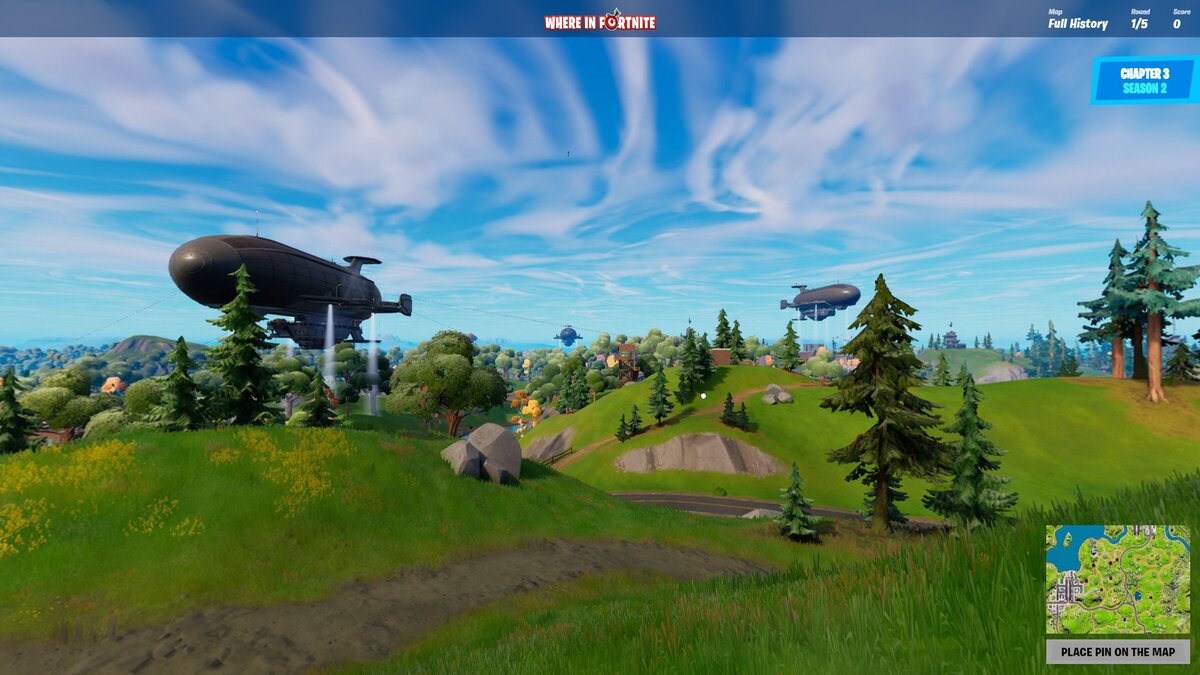
  • Where in Fortnite Navigation: Navigate to the native web client, configure customizable parameters including round timers, pan limits, or zoom restrictions, and toggle Night Mode to test advanced acoustic and silhouette triangulation skills.
  • UEFN Creative Client Navigation: Launch the Fortnite game client, navigate directly to the Discover tab, input the dedicated island code 4749-0459-3824, spawn inside the lobby environment, examine the panoramic skybox, and confirm map placements by shooting the interactive coordinate grid.

Strategic Pitfalls and Professional Competitive Meta-Strategies

Competitive matches highlight critical mechanical traps and advanced strategies utilized by elite players.

  • The Altitude Displacement Trap: In 2D browser interfaces, players often overcompensate for vertical depth in mountainous biomes (such as Classified Canyon) and misalign their horizontal pins. Conversely, in UEFN environments, players frequently fail to realize that the zless custom function completely ignores vertical elevation, leading to unnecessary horizontal adjustments.
  • Grassland Biome Misidentification: The transition of art styles across historical map revisions has created visually uniform fields. Players who rely solely on default grass textures often place pins on incorrect map epochs.
  • Farmland Miscalculation: Highly uniform agricultural zones (such as Frenzy Farm) contain minor soil color shifts and crop row directions that players routinely miscalculate, leading to significant distance penalties.
  • No Move Silhouette Triangulation: Champion division No Move rules restrict camera rotation and zoom, forcing players to orient themselves entirely by comparing background Level of Detail (LOD) assets and mountain silhouettes.
  • Night Mode Landmark Emitters: Under near-zero visibility conditions, players must rely exclusively on visual glow emitters (such as neon signs and rift particles) and spatial audio steps to triangulate positions.
  • Region-Guessing Frameworks: High-tier players apply systematic asset-profiling techniques. For example, classifying localized variants of wooden fences, brick structures, and small generic shacks enables players to immediately distinguish visually identical biomes across map variations.

Twinfinite is supported by our audience. When you purchase through links on our site, we may earn a small affiliate commission. Learn more about our Affiliate Policy
Explore the GAMURS Network
Author
Image of Jorge Aguilar
Jorge Aguilar
Aggy has worked for multiple sites as a writer and editor, and has been a managing editor for sites that have dozens of millions of views a month. He's been the Lead of Social Content for a site garnering millions of views a month, and co owns multiple successful social media channels, including a Gaming news TikTok, and a Facebook Fortnite page with over 700k followers. His work includes Dot Esports, Screen Rant, How To Geek Try Hard Guides, PC Invasion, Pro Game Guides, Android Police, N4G, WePC, Sportskeeda, and GFinity Esports. He has also published two games under Tales and is currently working on one with Choice of Games. He has written and illustrated a number of books, including for children, and has a comic under his belt.
Author
Image of Shubhendu Vatsa
Shubhendu Vatsa
A Comic book nerd whose favorite superheroes are Batman, Wolverine, and Spider-Man. He also plays an unhealthy amount of video games.
Author
Image of Chris Jecks
Chris Jecks
Managing Editor
Chris Jecks has been covering the games industry for over eight years. He typically covers new releases, FIFA, Fortnite, any good shooters, and loves nothing more than a good Pro Clubs session with the lads. Chris has a History degree from the University of Central Lancashire. He spends his days eagerly awaiting the release of BioShock 4.