


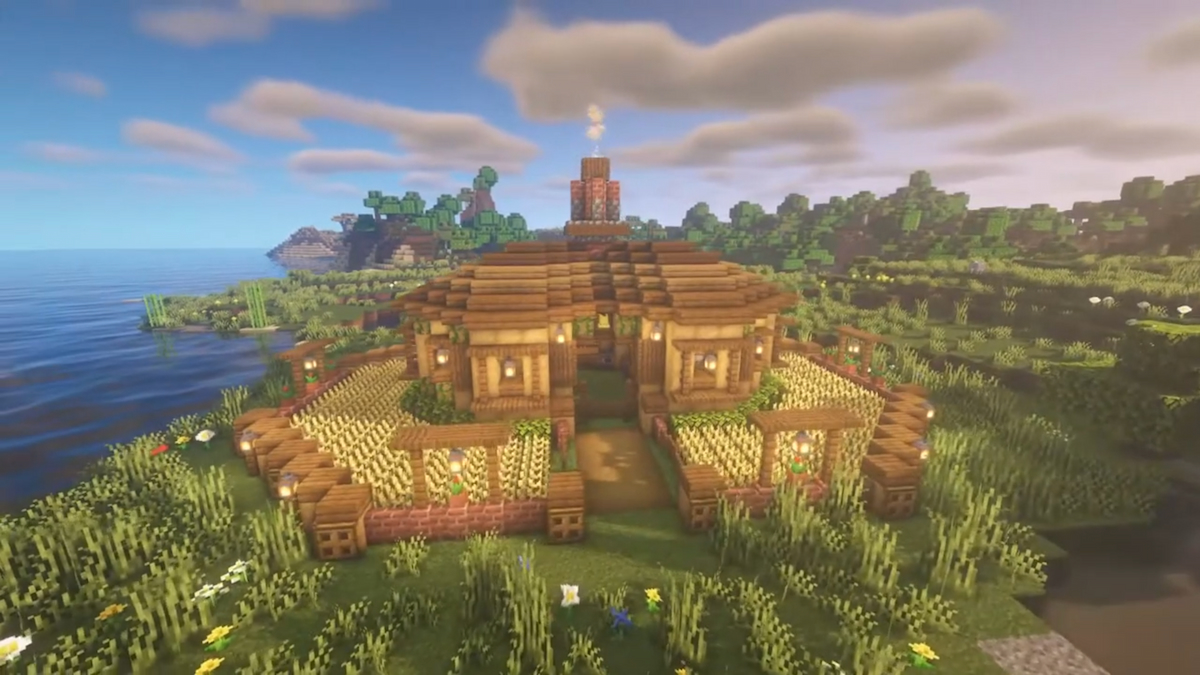
When I first started playing Minecraft, I was like most people: I spent my nights in a dirt hole and my days chasing cows across the plains with a handful of wheat. But as my worlds grew, I realized that a random pile of animals in a fence is not just an eyesore; it is a massive waste of potential. Whether you are playing on a massive server or a private survival world, building a proper barn is the turning point where you stop being a nomad and start being a master of your environment.
In this guide, I am going to show you how to move past the basic wooden box and build structures that actually work with the game engine. We are talking about 1.21 automation, the weird math of animal growth, and how to stop your mobs from mysteriously disappearing.
Building for Efficiency: The Math of Mob Breeding
I have spent way too much time staring at cows to realize that animal husbandry is actually a numbers game. In Minecraft, mobs do not grow linearly. If you start with two cows and breed them every five minutes, the population follows an exponential recurrence relation. The formula for your population after each cycle is an+1 = [3/2an].
If you want to know exactly how many animals you will have after 10 breeding cycles, you can use the formula:
an = [K times (3/2)n]
In this case, K is a constant approximately equal to 1.08151366859. For 10 cycles, that is about 63 animals. If your barn is not designed to handle that growth, you are going to hit the entity cramming limit fast.
- Animal breeding has a fixed five minute cooldown that you cannot change in vanilla.
- Maturation takes 20 minutes, but you can speed it up by 10 percent every time you feed a baby.
- The default max entity cramming rule is 24, meaning once you hit 25 mobs in one block, they start suffocating.
Why Your Animals Keep Dying: Chunk Boundaries and Cramming
Have you ever logged into your world and noticed half your sheep are gone? I used to think it was a glitch, but it is actually a spatial data issue. When Minecraft loads a chunk, entities sometimes load a few ticks before the blocks around them. If your animals are standing right against a fence on a chunk boundary, they can wander into the space where the fence should be. When the fence finally loads, the animal gets stuck inside the block and suffocates.
To fix this in my own builds, I always use the F3 and G trick to see chunk borders. I make sure my animal pens are at least one block away from the boundary line. Another pro tip I learned is the vine exploit. If you place a climbable block like vines or a ladder in a 1×1 hole, it disables the collision math for those mobs. I have used this to keep hundreds of cows in a single block for a semi-automatic farm without a single one taking cramming damage.
The 1.21 Automated Compactor Barn

This is my absolute favorite design for the current update. It looks like a classic red barn on the outside, but the basement is where the magic happens. By using the new Crafter block introduced in 1.21, I can feed leather and wool directly into a 3×3 grid that automatically turns them into blocks.
- You can set the Crafter to compact raw items by disabling specific slots in its interface.
- This increases your storage density by 900 percent.
- I recommend using a simple redstone clock with two repeaters to pulse the Crafter whenever it gets items from your hoppers.
The Multi-Story Husbandry Engine
If you are looking for more than just aesthetics, this vertically swapped arrangement is the way to go. I keep the animals on the ground floor and my living quarters in the loft. This is not just for style; it ensures that while I am sleeping or enchanting, the animals stay within my 128 block simulation distance. If they are too far away, they stop ticking and do not grow or produce items. This build looks great when paired with some of the best Minecraft castle ideas for a full estate vibe.
The 1.21 Armadillo and Scute Foundry
With the addition of wolf armor, I had to build a specialized space for armadillos. These little guys are sensitive. If you sprint near them, they curl up and stop producing. My design uses soft lighting from glow berries to keep the savanna vibe while preventing hostile mobs from spawning.
- Armadillos drop scutes every 5 to 10 minutes naturally.
- You can use a brush to get scutes instantly, but it eats durability fast.
- I found that a single unenchanted brush only gives about 4 or 5 scutes before it breaks.
The Medieval Butcher Stronghold
This design is all about lore and environmental storytelling. According to common theories, villagers and players share a common ancestor but diverged because the Ancient Builders wanted a pacifist workforce. This barn honors that by integrating a Butcher villager station. By placing Smokers inside the barn, you can trade your raw meat for emeralds instantly. It turns your barn into a self sustaining economy.
The Spring to Life Cottagecore Barn

For those of us who love the 2025 aesthetics, I suggest using Cherry wood and Pale Oak. The Spring to Life update introduced biome-based mob variants that look incredible in a cottagecore setting. I like to use scaffolding as display tables for potted plants and hang vines from the roof to simulate a building that is being reclaimed by nature. This is a perfect starter for anyone looking for the Minecraft bedroom ideas that still have character.
The 1.21 Sniffer Sanctuary
Sniffers are massive, so they need a barn that respects their pathfinding AI. I built mine as a large circular enclosure because circles break the boring voxel grid and give the Sniffer more room to dig.
- Sniffers need a 6×6 area of moss or dirt minimum to dig for ancient seeds.
- They store the last 20 locations they have dug in their memory, so you need a large floor to keep them productive.
- I use hopper minecarts under the floor to pick up the Torchflower seeds they find.
The Subterranean Pokéball Vault
If you are like me and hate cluttering up your beautiful landscape, build your barn underground. This futuristic vault uses a glass dome flush with the surface. I call it the Pokéball because it has four distinct rooms branching off a central hub. It is surprisingly efficient because you can put a single tree in the center to house bees for honey production in the same space as your sheep and cows.
The Regenerative Silvopasture Barn
This is a build for the eco-conscious player. I integrate tree farming directly into the animal pens. The livestock provides bone meal through composters, which I then use to grow the Spruce trees that provide the wood for the barn itself. It is a closed loop system. In my experience, Spruce is the most efficient wood to use because you can grow 2×2 Mega Spruce trees for massive log yields.
The Ethical AFK Sanctuary

I know a lot of people like the 1×1 torture chambers for maximum efficiency, but I prefer a more homey feel. This design uses redstone pressure plates in a large pen. When a sheep wanders over a plate, it triggers a hidden dispenser with shears. It is not as fast as a traditional farm, but it lets your animals roam free and still gives you more wool than you will ever need.
The 1.21 Universal Resource Foundry
This is the end game barn. It uses a series of five Crafters to handle everything from animal drops to wood and iron. By linking a cow farm and a tree farm to this system, I can automatically craft items like Pistons and Dispensers.
- 1 log yields 4 planks, which can be turned into 8 sticks.
- Using the Crafter, you can automate the entire chain without ever opening a crafting table.
- The gathering ROI is highest for Spruce and Cobblestone, making them the ideal materials for this industrial scale build.
Choosing the Right Materials: Survival ROI
When you are building in survival, time is your most valuable resource. I use a simple formula to decide which blocks are worth my time:
Ticks = round(30 times BlockStrength/DigSpeed
Spruce logs have a hardness of 2.0, while materials like Calcite are much harder to find and gather in bulk. I always recommend Spruce for barns because one block of wood yields 1.5 furnace operations, but if you process it into 4 planks, you get 6 operations. That is a 400 percent fuel efficiency gain just by taking two seconds to craft.
Whether you are looking for a simple place to store your horses or a fully automated 1.21 factory, these ideas will help you get the most out of your world. If you are just starting a new save, check out some of the best Minecraft seeds to find the perfect location for your new barn.














Updated: Apr 7, 2026 08:55 pm