


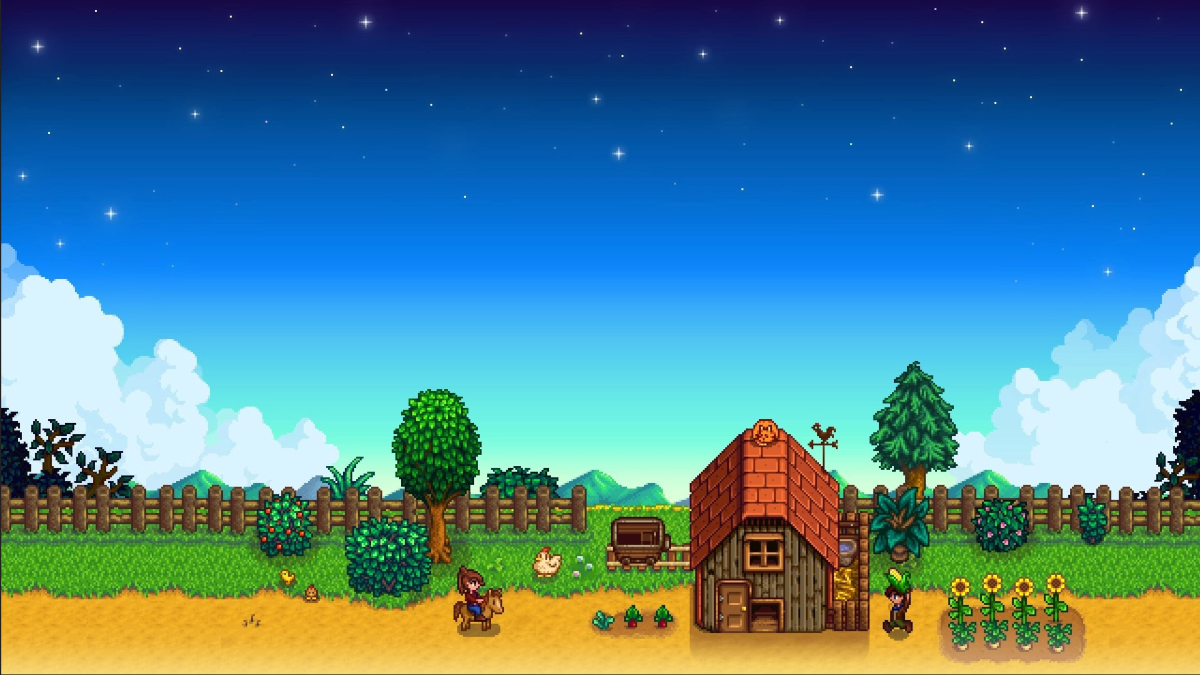
To maximize Walleye extraction efficiency in Stardew Valley fishing, advanced players must target the Cindersap Forest Pond during rainy Fall evenings or deploy Rain Totems in Winter while avoiding priority event overlaps. Processing raw catches through the Fish Smoker while stacking the Angler and Artisan professions yields a 4.20 price multiplier over base value, establishing an optimal aquaculture profit loop.
Environmental Validation Scripts and Weather Overrides
The spawning engine governing the acquisition of the Walleye operates through an environmental validation script within the core game loop. The spawn algorithm returns a null state unless three environmental criteria resolve to true simultaneously: Fall season, active Rain, and a time window between 12:00 PM and 2:00 AM.
Under standard conditions, natural rain occurs only in Spring, Summer, and Fall. Because the weather engine processes Winter precipitation strictly as snow, natural Winter weather cannot satisfy the rain condition required for Walleye spawning. Advanced players utilize two mechanical overrides to bypass this seasonal bottleneck: the Rain Totem override and the Magic Bait override.
Unlocking the Rain Totem at Foraging Level 9 allows players to force the weather variable on day t+1 to resolve as rainy. Deploying a Rain Totem during Winter forces artificial rain, enabling the freshwater Walleye spawn script to execute during its designated time window. However, fixed seasonal events possess absolute priority in the weather rendering queue. Deploying a Rain Totem on the day preceding fixed calendar events, such as the Night Market on Winter 15 to 17, results in the event script overwriting the forced rain flag, wasting the totem and resulting in zero spawn checks.
Magic Bait, purchased from Mr. Qi’s Walnut Room on Ginger Island, completely detaches the fishing lookup table from active map environmental flags. When equipped on a Fiberglass or Iridium Rod, Magic Bait skips conditional checks for season, weather, and time, allowing the Walleye to spawn in any freshwater body under any weather state at any hour.
| Environmental Variable | Baseline Required State | Override State and Mechanics | Engine Bypass Mechanics |
|---|---|---|---|
| Seasonal Window | Fall | Any season via Magic Bait | Bypasses seasonal array checks in location lookup tables |
| Weather Flag | Active Rain | Rain Totem in Winter or Magic Bait | Forces rain state on day t+1 or ignores weather check |
| Time Window | 12:00 PM to 2:00 AM | Magic Bait | Bypasses diurnal time check array |
Mathematical Models of Fishing Engine Mechanics
Bite Delay and Minigame Geometry
When fishing for Walleye, the delay before a bite occurs is determined by a random float t(base) generated between 0.6 and 30.0 seconds. The active bite wait time t(bite) is modified by player level and tackle using the following equation:
t(bite) = t(base) – 0.25 x L(fishing) – t(tackle)
In this formula, t(bite) represents the active bite delay in seconds, t(base) represents the randomly rolled base time, L(fishing) is the effective Fishing level including food buffs, and t(tackle) is the flat reduction granted by tackle. Standard Bait reduces t(base) by 50 percent prior to subtraction, while Spinner tackle applies a t(tackle) value of 5.0 seconds and Dressed Spinner applies 10.0 seconds. The calculated delay cannot drop below a hard floor of 0.5 seconds.
The vertical canvas of the fishing minigame spans a total height of 568 pixels. The pixel length of the green paddle bar L(bar) dictates catch difficulty and is calculated as:
L(bar) = 96 + 8 x L(fishing) + L(tackle)
At Fishing Level 0, bar length starts at 96 pixels and increases by 8 pixels per level, reaching 176 pixels at Level 10. Cork Bobber adds a static 16 pixels to L(tackle). The Training Rod forces L(fishing) to simulate Level 5 (136 pixels) for natural levels below 5, while restricting catches to fish with difficulty under 50. Because Walleye possesses a difficulty rating of 45 and smooth movement behavior, it remains fully catchable on the Training Rod.
Sizing Factor Dynamics and Quality Tiers
Casting distance determines both Fishing Zone depth D (capped at 5 tiles from land) and the programmatic sizing factor fishSize. The calculation incorporates effective level S and an environmental fluctuation integer R bounded between 90 and 110. The resulting fishSize value is clamped between 0.0 and 1.0.
Base catch quality maps directly to fishSize, where values under 0.33 yield Normal quality, values from 0.33 to 0.66 yield Silver quality, and values of 0.66 or greater yield Gold quality. Executing a perfect catch upgrades quality by one tier, but only if the pre-catch calculation yields Silver quality or higher. If low casting depth or low level produces a base fishSize mapping to Normal quality, a perfect catch will not upgrade the fish to Silver.
| Fishing Zone | Effective Fishing Level | Minimum Sizing Factor | Maximum Sizing Factor | Base Normal Quality Probability | Base Silver Quality Probability | Base Gold Quality Probability |
|---|---|---|---|---|---|---|
| Zone 1 | Level 0 to 1 | 0.04 | 0.22 | 100% | 0% | 0% |
| Zone 1 | Level 10 to 11 | 0.22 | 0.26 | 100% | 0% | 0% |
| Zone 2 | Level 0 to 1 | 0.07 | 0.44 | 73% | 27% | 0% |
| Zone 2 | Level 10 to 11 | 0.43 | 0.53 | 0% | 100% | 0% |
| Zone 3 | Level 4 to 5 | 0.32 | 0.66 | 3% | 95% | 2% |
| Zone 3 | Level 10 to 11 | 0.65 | 0.79 | 0% | 10% | 90% |
| Zone 5 | Level 0 to 1 | 0.18 | 1.00 | 20% | 39% | 41% |
| Zone 5 | Level 8 to 9 | 0.90 | 1.00 | 0% | 0% | 100% |
Sizing Decay and Experience Allocation
The physical length of the Walleye in inches is calculated through the following equation:
Size(Walleye) = floor(10 + 31 x fishSize + 1)
During minigame execution, keeping the fish icon outside the green paddle bar triggers real-time decay: every 800 milliseconds outside the bar reduces physical size by 1 inch, down to a floor of 10 inches. For imperfect catches reaching the calculated maximum of 41 inches, the engine applies a mandatory 1-inch penalty. Bypassing this penalty through a perfect catch or maintaining under 800 milliseconds of total error in Zone 5 enables players to reach an absolute maximum length of 42 inches.
Experience points XP earned upon capture scale with fish difficulty D(fish) = 45 and quality factor Q, where Normal equals 0, Silver equals 1, Gold equals 2, and Iridium equals 4:
XP = floor((Q + 1) x 3 + D(fish) / 3)
Evaluating this model produces baseline experience yields of 18 XP for Normal, 21 XP for Silver, 24 XP for Gold, and 30 XP for Iridium. Perfect catches apply a flat 2.4 multiplier to total experience, raising an Iridium Walleye catch to 72 XP.
Spatial Distribution and Map Routing Mechanics
Walleye spawn densities vary across freshwater bodies due to competing fish pools in location tables. The Cindersap Forest Pond features a highly restricted fish pool during rainy Fall evenings, delivering a 32 percent hook probability per successful cast. Conversely, the Pelican Town River and Mountain Lake contain expanded tables with high-priority competing species like Catfish and Salmon, lowering net Walleye hook rates.
Decompiled code within the Farm::getFish method reveals explicit spatial routing rules for custom farm layouts. On the Four Corners Farm, the southwest quadrant pond routes 50 percent of its checks to the Forest Pond table, yielding a net 16.0 percent Walleye probability per cast on rainy Fall days, while the other three quadrant ponds yield 100 percent trash.
On the Meadowlands Farm, standing ponds are disconnected from freshwater pools: the left pond yields 100 percent trash, while middle and right ponds route to specialized Crab Pot item pools. The central river corridor on Meadowlands routes 40 percent of checks to the Forest Pond pool, producing a net 12.8 percent Walleye spawn chance. Main ponds on the Forest Farm route 45 percent of checks to the Forest Pond pool and 5 percent to the Woodskip table, yielding a net 14.4 percent Walleye probability.
| Farm Map Layout | Primary Water Body Type | Underlying Database Source | Net Walleye Catch Probability | Trash Rate |
|---|---|---|---|---|
| Standard Farm | Central and Southern Ponds | Trash Database Only | 0.0% | 100% |
| Riverland Farm | Ponds and Streams | 70% Pelican Town River / 30% Cindersap Pond | ~9.6% | Low |
| Forest Farm | Main Ponds | 5% Woodskip / 45% Cindersap Pond | ~14.4% | Moderate |
| Hill-top Farm | Mountain Stream | 50% Cindersap Forest River | Variable | ~50% |
| Wilderness Farm | Southwest Lake | 35% Mountain Lake Pool | Variable | ~65% |
| Four Corners Farm | Southwest Quadrant Pond | 50% Cindersap Forest Pond | 16.0% | Low |
| Four Corners Farm | Other Quadrants | Trash Database Only | 0.0% | 100% |
| Meadowlands Farm | Crossing River Stream | 40% Cindersap Pond / 60% Trash | 12.8% | 60% |
| Meadowlands Farm | Left Pond | Trash Database Only | 0.0% | 100% |
| Meadowlands Farm | Middle and Right Ponds | Specialized Crab Pot Pools | 0.0% | N/A |
| Beach Farm | Inland Ponds | Trash Database Only | 0.0% | 100% |
Artisan Economy and Multiplicative Profession Stacking
The Fish Smoker processes raw fish and 1 Coal over 50 in-game minutes. Constructing a unit requires 10 Hardwood, 1 Sea Jelly, 1 River Jelly, and 1 Cave Jelly.
Smoking applies a base 2.0 multiplier to raw fish value while preserving quality tier. Because smoked fish are reclassified as Artisan Goods while retaining fish identity, final sell prices benefit from multiplicative profession stacking. Combining a fishing profession bonus P(fishing) (Fisher at 0.25 or Angler at 0.50) with the Tiller-derived Artisan profession bonus P(artisan) = 0.40 yields the following price equation:
Price(smoked) = Price(raw base) x Multiplier(quality) x 2 x (1 + P(fishing)) x (1 + P(artisan))
For an end-game build utilizing both Angler (+50 percent) and Artisan (+40 percent) professions, the calculation simplifies to:
Price(smoked) = Price(raw) x 2 x 1.50 x 1.40 = Price(raw) x 4.20
| Quality Tier | Raw Base Value | Raw with Fisher (+25%) | Raw with Angler (+50%) | Smoked Base Value | Smoked with Fisher and Artisan | Smoked with Angler and Artisan |
|---|---|---|---|---|---|---|
| Normal | 105g | 131g | 157g | 210g | 367g | 441g |
| Silver | 131g | 163g | 196g | 262g | 458g | 550g |
| Gold | 157g | 196g | 235g | 314g | 549g | 659g |
| Iridium | 210g | 262g | 315g | 420g | 735g | 882g |
Because Smoked Walleye carries the Artisan class tag, Willy refuses to purchase it at the Fish Shop docks; items must be sold via the Shipping Bin or Pierre’s General Store.
Targeted Bait Mechanics and Species Comparison
Targeted Bait created in the Bait Maker modifies hook behavior depending on species parameters. Walleye Bait applies a standard 1.66 multiplier to Locational Chance and Spawn Rate. Because the Walleye Spawn Rate is capped at 0.9, this 1.66 multiplier virtually guarantees passing spawn checks.
In contrast, the Goby is programmatically exempt from the 1.66 multiplier. Goby Bait instead grants a static +20 percent boost to Locational Chance and bypasses Spawn Rate checks entirely. Furthermore, while Goby lists a maximum database size of 13 inches, catching a Goby larger than 11 inches is mathematically impossible under standard gameplay. The waterfall basin where Goby spawns has a maximum Distance from Land D = 2, capping fishSize at 0.7992 even at Fishing Level 16.
Targeting Goby presents another mechanical trap: the waterfall basin target coordinates are mapped 5 tiles away on the grid despite appearing visually adjacent to the southern cliff. This dead zone requires an effective Fishing Level of at least 4 to reach the casting distance required.
| Attribute Parameter | Walleye Mechanics | Goby Mechanics |
|---|---|---|
| Primary Spawn Location | Rivers, Mountain Lake, Forest Pond | Southern Waterfall Basin |
| Seasonal Availability | Fall (Winter with Rain Totem) | Year-Round |
| Weather Requirement | Active Rain | Any Weather |
| Database Size Bounds | 10 to 41 inches | 3 to 13 inches |
| Hard In-Game Size Cap | 42 inches (Perfect Catch, Zone 5) | 11 inches (Restricted by tile distance limit) |
| Targeted Bait Effect | 1.66 multiplier to Locational Chance and Spawn Rate | Exempt from multiplier; applies static +20% Locational Chance |
| Base Sell Value (Normal) | 105g | 150g |
Aquaculture Husbandry and Utility Metrics
Placing a Walleye in a Fish Pond sets an initial capacity of 3 fish, reproducing every 3 days up to a maximum capacity of 10 fish upon completing population quests.
| Starting Population | Target Population | Required Quest Items | Fishing XP Awarded |
|---|---|---|---|
| 3 Fish | 5 Fish | 3 Acorns, 10 Bug Meat, 3 Maple Seeds, or 3 Pine Cones | 35 XP |
| 5 Fish | 7 Fish | 3 Gold Ore, 1 Maple Syrup, or 5 Mixed Seeds | 35 XP |
| 7 Fish | 10 Fish | 1 Crayfish, 1 Honey, 2 Jade, or 1 Periwinkle | 35 XP |
Walleye Ponds produce yellow Walleye Roe. Roe price scales with raw base fish price, where Price(raw base) = 105g:
Price(roe) = 30 + floor(Price(raw base) / 2)
Evaluating this formula yields Price(roe) = 30 + 52 = 82g. Processing roe in a Preserves Jar creates Aged Roe worth 164g, or 229g with the Artisan profession.
Walleye satisfies the Night Fishing Bundle in the Fish Tank, as well as the Quality Fish Bundle in remixed setups when Gold or Iridium quality. It serves as generic fish input for Quality Fertilizer (1 Fish plus 4 Sap), Maki Roll (1 Fish, 1 Seaweed, 1 Rice), and Sashimi. Tailoring a Walleye with 1 Cloth creates the Fishing Vest, and it acts as yellow dye at 2 Willow Lane. Demetrius, Elliott, Leo, Linus, Pam, Sebastian, and Willy respond neutrally to raw Walleye gifts, while all other villagers dislike or hate it. Pierre’s Help Wanted board may request a Walleye during Fall or Winter, awarding 315g and 150 Friendship points.
Optimal End Game Meta Execution
During early-game Fall Year 1, players should fish the Cindersap Forest Pond from 12:00 PM to 2:00 AM on rainy days, using the Training Rod if Fishing level is under 5 to maintain a 136-pixel paddle bar.
As progression advances, raw catches should be converted into Targeted Walleye Bait using the Bait Maker to guarantee passing spawn checks with the 1.66 multiplier. In Winter, players should trigger rain using Rain Totems while carefully avoiding fixed calendar events like the Night Market on Winter 15 to 17.
All harvested Walleye should be processed through Fish Smokers and sold through Pierre or the Shipping Bin under an Angler and Artisan profession build to capture the maximum 4.20 price multiplier.













Updated: Jul 29, 2026 06:20 pm