


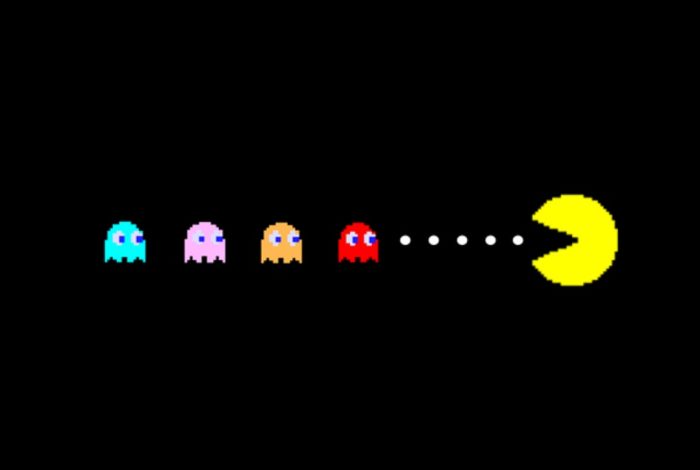

For the next month, Pac-Man and Sonic the Hedgehog will be dabbling in each other’s specialties in a grand celebration of what makes these two iconic figures great. And although Sonic has fallen into a few proverbial spike pits over the last decade, Pac-Man just keeps right on Pac-Manning, often repackaging and re-purposing the same game we’ve seen hundreds of times since its debut in 1980.
It’s interesting to note the continued success of this formula, with the official app on iOS holding a sturdy four out of five stars. Ecstatic reviewers claim that the game is ‘geourgeous’, and that ‘when I go we’re I wanna go it will take me to the baddies’ (for Latin majors, the phrase sic erat scriptum may come to mind).
So what is it that keeps this unassuming arcade classic so relevant in today’s era? Let’s dissect an oldie, but a goodie. For as Pac once said, ‘There’s nobody in the business strong enough to scare me.’ Not sure which game that was from, but there you go.
Simplicity and Accessibility

80s arcade titles work on a basic premise where most of the answers are apparent right from the start. You’re a little yellow man, and there are ghosts roaming about the stage. When you move around, you eat dots. Without any other cues beyond that, it’s quite obvious that you ought to keep collecting those dots, and that those ghosts probably aren’t your friends. When you eat a bigger dot, the ghosts change color, and appear perturbed. They are also beginning to actively flee from you, so unless you are the most cautious gamer of all time, your inclination is to try and combat the ghosts. You devour their very flesh, they retreat to their base, the cycle repeats.
There is no need for any explanation beyond that. The language of Pac-Man is universal, and the goals and dangers are just as clear to a person playing in Brazil as it is to someone in Timbuktu. There is no prerequisite for enjoyment, and if you had never picked up a game in all of your life, you still won’t be baffled by the gameplay. The only difference between a novice player and a more experienced one will be their level of success in completing the challenge, and that is entirely up to them.
Flexibility

Expounding on the previous point further, the clear goals and expectations of the base Pac-Man formula make it an attractive game for all skill levels. But beyond this, its simplicity also allows for an element of flexibility and adjustment to be made, in order to entice repeat purchases time and time again.
Looking at the aforementioned iOS app, it features a selection of new maps to freshen things up. This doesn’t compromise the simplicity, but builds on it in a way that feels natural and reasonable. Sometimes, more bold design choices are made, to mixed results. In Ms. Pac-Man, the behavioural patterns of the ghosts was adjusted to include moments of chaotic randomness, thus preventing a knowledge of their movements as a predictive path to success. There were also other minor aesthetic improvements made, in addition. Once again, nothing that broke the mold, but enough to enhance the experience as a whole. Pac-Man Jr. expanded the maps so widely, it required a moving camera to track the player. Not quite as user-friendly, but again, not overly obstructive.
Another thing worth considering is that the listed examples weren’t even officially licensed Namco games. The Pac-Man formula is pliable and enviable, to the point where other developers looked to ride the wave of success. One can only imagine how many Pac-Man clones exist out there, each with their own quirks to differentiate themselves.
High Scores and Modern Gaming

Back in the golden era of arcade gaming, high scores were of utmost importance. The idea that your initials would be displayed there at the top of a list for all to see, a declaration of your superiority and a pinnacle that others would hope to achieve. The quarters sunk into a machine were not only a challenge made to the game, but to the person ranked #1. Whoever this mysterious ‘ABE’ was, one thing was certain: they were a target, a goal, an obstacle – it was the closest thing we had to a god complex back in our youth.
As gaming transitioned to the console market, high scores became less relevant. Other than bragging rights against your friends and your baby sister who likes to chew on the joystick, you weren’t really showing off to anyone. During this time, Pac-Man underwent a desperate series of transformations to try to stay afloat. Other than the titular hero and his cast of characters, what did Pac-Man 2: The New Adventures really have to do with Pac-Man at all? Not much. The only noteworthy revelation is that Pac-Man is an absolute jerk, and tormenting him was half the fun.
Trends in gaming have proven to be cyclical, however, and the advent of mobile gaming has breathed new life into the arcade-style genre, where the goal is not your ultimate success, but to outdo the efforts of others. As game designer Scott Rogers observed in his book Swipe This! The Guide to Great Touchscreen Game Design, ‘modern gaming lets you display your entire name to the whole world – which makes the bragging all that much sweeter’.
If all of this sounds a bit too pedantic for your taste, it can be summarized thusly: we’re totes full of ourselves and want to show off our mad Pac skillz. Take a selfie with your high score and post it on your Insta, it’s lit! (100 emoji) (raised hands emoji) (obscene eggplant emoji)
Status as an Icon

Here are a list of things from 1980: Pac-Man, Post-It notes, the Rubik’s Cube and the Staggers Act. Unless you are especially fond of puzzles, stationery or the deregulation of the United States Rail Industry, it’s fair to say that only one of those would make for a cool tattoo. Pac-Man is synonymous with gaming, and more specifically, retro gaming. Even the more modern depiction of the character, complete with arms, legs and a nose, of all things, holds recognition as a legacy brand.
Most everyone knows Pac-Man; his visage is instantly recognizable, and can evoke positive feelings of nostalgia. You know who he is, you know what he does, just one look at that lovable face can fill your mind with ‘wakka wakka wakka’ sound effects. The thing about this, is that unless you’ve grown fatigued from over-saturation (certainly possible if you’re one of the people who have already bought Pac-Man games on multiple occasions), you have no reason to dislike the character. For the most part, the only negative response would be one of apathy or indifference. The game isn’t for everyone. But for the reasons we’ve already looked at, it is in fact for a large majority of people, and that is as much based on what Pac-Man has come to represent, as for what he actually does.
Plus, Peter Quill once took on the form of Pac-Man in order to fight an immortal. If that doesn’t say good things about your protagonist, I don’t know what does.







Updated: Feb 22, 2018 11:01 am