


Maximizing late-game viability across high-curse runs requires bypassing additive passive stat limits through multiplicative Arcana multipliers while timing evolution chest collections around engine spawn mechanics. Players must combine spatial inventory overfill paths with low-particle weapon configurations to prevent render bottlenecks and optimize damage throughput.
Mathematical Stat Pipeline and Statutory Engine Hard Caps
The core engine processes character stat alterations using a strict two-tier mathematical pipeline consisting of standard additive passive pooling followed by an independent multiplicative Arcana operator.
S(total) = (100% + S(additive)) x M(arcana)
In this calculation, S(total) represents the final attribute value applied to the weapon output, S(additive) constitutes the cumulative sum of passive items, level-up card selections, Golden Egg increments, and character traits, and M(arcana) is the multiplicative modifier applied exclusively by active Arcanas such as Boogaloo of Illusions (XVIII).
Under standard play, additive pools for Might, Area, Growth, and Greed enforce a hard cap of +1000%. Any passive items or Golden Eggs collected after hitting the +1000% threshold yield zero functional scaling in combat. Because M(arcana) is processed as an external scalar, it completely bypasses the +1000% ceiling, allowing players to scale weapon hitboxes and damage parameters beyond standard system limits.
Player stats adhere to strict operational boundaries during standard runs and Limit Break states.
| Player Attribute | Additive Hard Cap | Limit Break Scaling Behavior | Primary Passive Source |
|---|---|---|---|
| Might | +1000% | Unlimited scaling during Limit Break | Spinach |
| Area | +1000% | Weapon dependent sub-caps of +400%, +500%, or +1000% | Candelabrador |
| Growth | +1000% | Standard utility cap scaling experience value per gem | Crown |
| Greed | +1000% | Gold acquisition multiplier | Stone Mask |
| Cooldown | -90% | Hard boundary that cannot be reduced further | Empty Tome |
| Amount | +10 Projectiles | Weapon dependent sub-caps of +5, +10, +20, or +30 | Duplicator |
| Duration | +500% | Baseline item cap with Limit Break sub-caps up to +15s | Spellbinder |
Specific evolved weapons incorporate datamined scaling formulas tied directly to utility stats. Vol Luminatio converts Growth directly into base damage, granting +40 Base Damage at 900% Growth and +50 Base Damage at the 1000% system cap.
Soul Eater scales its base damage based on cumulative active health points restored to the health bar. The flat damage bonus added to the weapon output is governed by the formula:
delta-D = min(60, floor(HP(healed) / 60))
In this equation, delta-D represents the flat damage added directly to Soul Eater base output, and HP(healed) represents the cumulative active health restored while below maximum HP. Any healing received while at full health is rejected by the update routine and does not increment the counter. This flat damage bonus completely ignores the character Might multiplier, capping at a maximum bonus of +60 base damage after restoring 3,600 active HP.
Soul Eater alters the baseline properties of Garlic upon evolution.
| Weapon State | Base Damage | Base Interval | Base Hitbox Area | Special Properties |
|---|---|---|---|---|
| Garlic Level 8 | 15 | 1.0s | 2.0 units | Reduces knockback resistance and increases freeze chance |
| Soul Eater | 20 | 1.0s | 2.5 units | Steals life on hit and scales damage via active healing |
Unlike Might or Area, the Curse attribute has no upper additive boundary. Curse scales additively across passive accessories including Torrona’s Box (+100% at Level 9), Skull O’Maniac (+50% at Level 5), Gold Ring (+40% at Level 9), and Metaglio Right (+40% at Level 9). Characters like Gyorunton scale Curse indefinitely at +1% per level. To prevent memory overflows under infinite Curse scaling, the game engine enforces a hard cap of 500 active monster sprites on screen simultaneously.
Golden Eggs permanently boost starting stats up to the theoretical limit of a 32-bit single-precision floating-point number, which equals 3.4028235 x 10^38. Performance profiling shows that stat calculations cease to scale past 30 digits of Golden Eggs due to CPU memory allocation limits and variable truncation.
Stage Evolution Timestamps and Spatial Overfill Mechanics
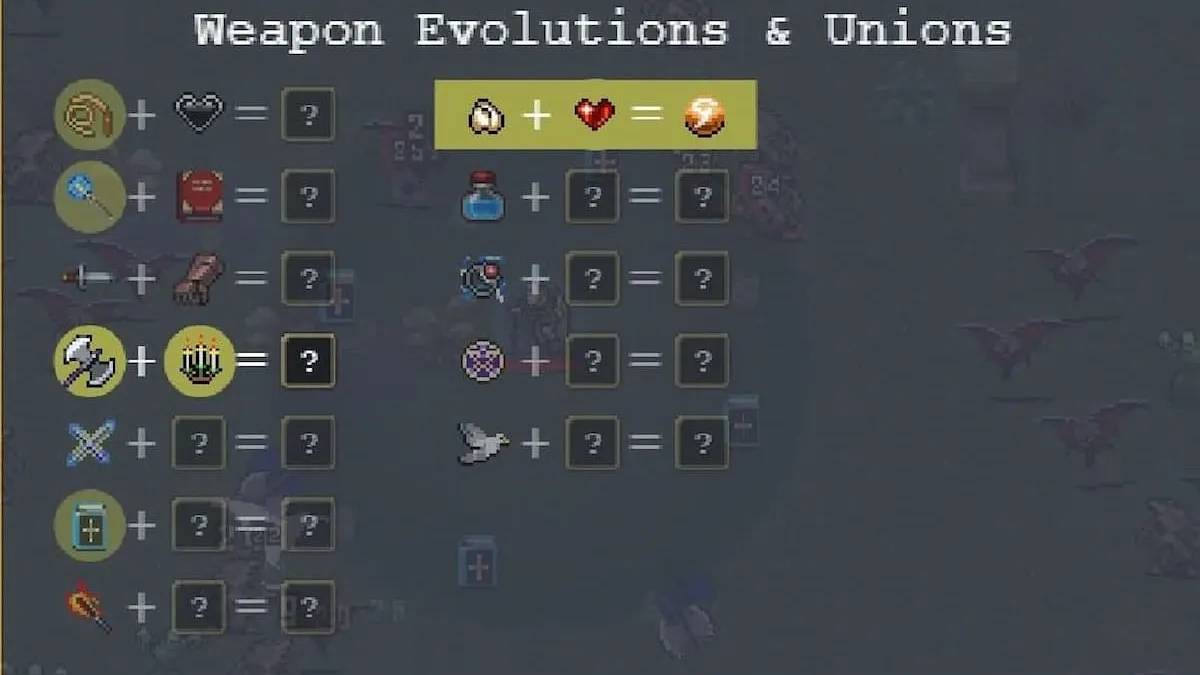
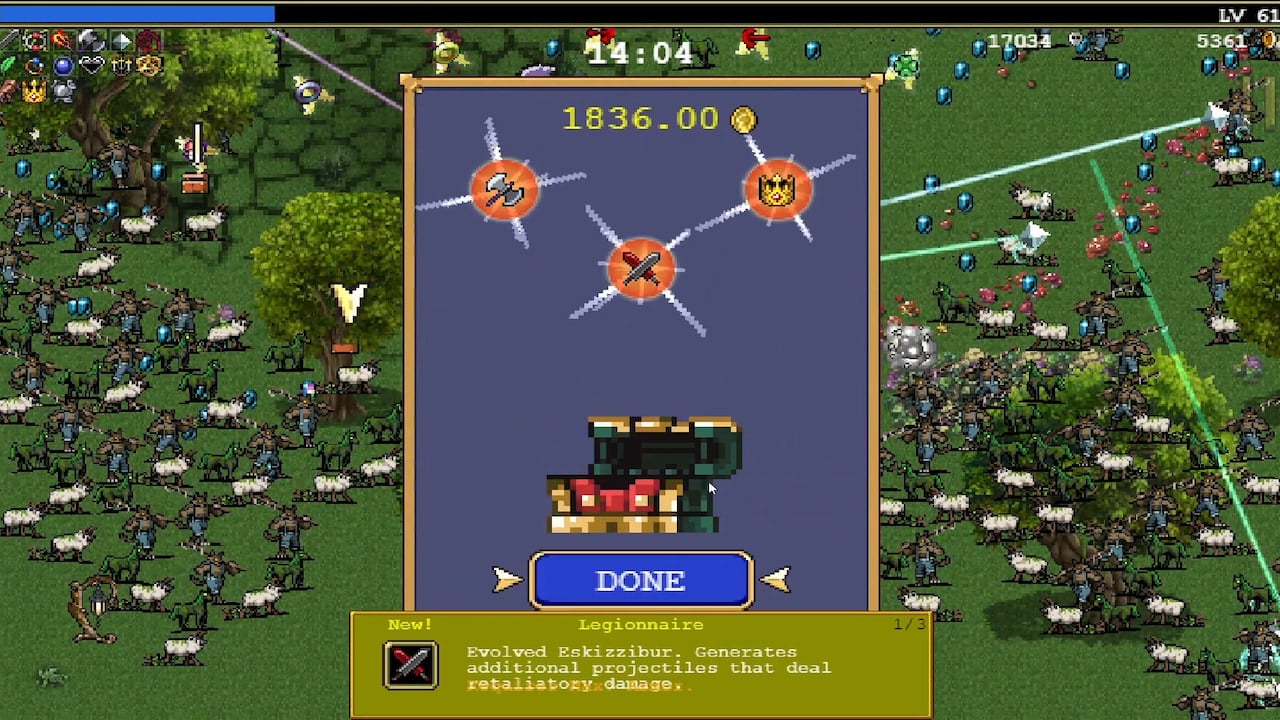
Triggering a weapon evolution requires leveling the primary weapon to level 8, holding at least level 1 of the required passive accessory, and opening a Treasure Chest dropped by an elite boss entity.
In standard stage configurations, boss chests only grant a weapon evolution if the boss entity spawned at or after the 10:00 mark on the stage timer. The engine checks the exact spawn timestamp of the monster sprite, not the time of its death or chest collection. If an elite boss spawns at 09:59 and dies at 10:05, its chest is coded to deny weapon evolutions.
Multiple stages bypass or alter the standard 10:00 timestamp requirement through hardcoded map logic. Dairy Plant allows every treasure chest dropped by elite bosses from 00:01 onward to evolve weapons. In Mad Forest, the unique glowing bat spawning at the 01:00 mark drops a chest that ignores the 10-minute lock. Cappella Magna and Il Molise feature initial boss chests that bypass the timer lock completely. On Tiny Bridge, all chests except those from the 03:00 and 06:00 bosses can trigger evolutions. On Lake Foscari, the Foscaritrice chest at 02:00 bypasses the lock, while Neo Galuga permits evolutions from the Metal Alien chest at 09:00. Treasure chests spawning at 11:00 and 21:00 that normally contain Arcanas can only trigger weapon evolutions if the player has reached the maximum Arcana inventory limit. Gyorunton possesses passive code that allows any chest pickup to trigger an evolution regardless of time.
Standard inventory limits restrict players to 6 active weapons and 6 passive accessories. By exploiting map geometry and static stage pickups, players can bypass the 6-slot passive cap to hold 8 or more passives simultaneously.
In Inlaid Library, players execute the overfill protocol by filling all six passive inventory slots through level-up selections. Traveling West along the top bookshelf boundary for approximately two real-world minutes leads to the static Empty Tome floor pickup, forcing it into slot 7. Reversing direction and traveling East for four horizontal map loops while hugging the northern boundary wall allows the player to collect the static Stone Mask, forcing it into slot 8.
In Gallo Tower, players navigate North from spawn while hugging the western vertical wall to locate the illuminated mirror asset behind flying bat spawns. Moving directly into the mirror collision box warps the character sprite into an isolated parallel room housing Concetta Caciotta’s coffin, bypassing standard spatial boundaries.
Algorithmic Economy Transmutations and Hardware Rendering Optimizations
Unlocking Sammy by defeating 6,000 Sammy enemies in Lake Foscari grants access to an automated coin conversion loop. Sammy begins runs with a -60% Might penalty but possesses a passive update loop that converts collected gold coins and coin sacks directly into experience points at a 1.1x multiplier (+10% bonus).
Sammy’s starting weapon, Vicious Hunger, rolls a probability check on every attack hit to transmute hit enemies into gold coin pickups. This probability is calculated as:
Chance(transmute) = min(0.65, 0.165 + 0.005 x Level) x Luck
In this formula, Chance(transmute) represents the probability of transmuting a hit enemy into gold coins, Level is Sammy’s current level, and Luck is the active Luck stat modifier. At Level 98, Sammy reaches the base transmutation cap of 70%, which is capped at 65% in the math limit prior to Luck scaling. When multiplied by standard Luck, almost every hit converts an enemy sprite into gold, triggering an immediate level-up that grants a Limit Break and triggers another attack cycle.
Because this gold to XP loop is processed as an overriding engine update, it ignores the leveling block of the Game Killer (0) Arcana. When Game Killer is active, standard gem XP is set to zero, but Sammy’s coin-experience loop continues functioning, allowing players to reach level 10,000 and acquire millions of gold within a shortened 15-minute run.
While Sammy achieves high early gold rates, Vicious Hunger creates a severe hardware bottleneck. The engine must instantiate, animate, and process physics for hundreds of individual cat and eye-sprite particle assets simultaneously. This overwhelms single-thread CPU performance, causing real-time frame rates to drop from 60 FPS down to single digits and stalling real-world gold generation.
To optimize real-world yield, players must transition to Big Trouser once accumulating approximately 1,000 Golden Eggs. By configuring Big Trouser with a single low-particle weapon such as Laurel paired with the Disco of Gold (XV) Arcana, the engine processes gold payouts at a locked 60 FPS, bypassing render queue lag and maximizing gold return per real-world minute.
Advanced Expansion Mechanics and Code Level Failure Points
The Emerald Diorama crossover update introduced the JRPG inspired Glimmer mechanic. When using SaGa series weapons, the engine runs an independent probability check on every attack execution to check if the character sparks a new technique, indicated by a lightbulb icon rendering over the character. Once sparked, the technique is added permanently to the character move pool, altering weapon attack parameters and unlocking multi-branch evolutions.
Glimmer spark probability scales directly with player Luck. If a character HP drops below 30%, they enter Showstopper Mode, which applies temporary scalars to Might, Cooldown reduction, and Luck, while forcing Glimmer spark probability to 100% on all attack cycles.
Upgrading the Splashing weapon shifts raw parameters and utility traits across each tier.
| Weapon Upgrade Tier | Mechanical Modification and Passive Attributes |
|---|---|
| Level 1 | Base damage scales with Duration; enables Glimmer checks for Dual Whirlwind |
| Level 2 | Base Area increased by +25% |
| Level 3 | Projectile active duration extended by +0.5s; Cooldown reduced by -0.3s |
| Level 4 | Base Area increased by +25%; Base Damage increased by +10 |
| Level 5 | Projectile active duration extended by +0.5s; Cooldown reduced by -0.3s |
| Level 6 | Base Area increased by +25%; Base Damage increased by +10; unlocks weapon globally |
| Level 7 | Projectile active duration extended by +0.5s; Cooldown reduced by -0.3s |
| Level 8 | Projectile active duration extended by +0.5s; Cooldown reduced by -0.3s |
The Punch weapon, starting arm of Bonnie Blair, uses a multi-stage sequential Glimmer chain requiring no passive accessories. Progression advances sequentially from Punch to Raksha, then to Shenlong Firefist, Pressure Point, and Gilded Hand. If an engine cycle fails to trigger the initial Raksha spark, the weapon remains locked out of both subsequent evolution stages.
Resolving the Gallo Tower web ARG unlocks the secret spell guinigigi. Entering this string into the Secrets menu grants the Chaos Rune, which evolves into Wicked Ruler when paired with a max-level Spellbinder. Wicked Ruler shockwave damage scales multiplicatively based on Projectile Speed and Duration.
Datamined exception logs reveal an engine instability when processing Wicked Ruler expansion vectors. In unpatched configurations, the main update cycle throws a runtime error within Vampire Survivors.Objects.Weapons.EX_Rune2_Weapon.InternalUpdate() during CharacterWeaponsManager.OnUpdate(). The game tweening manager, GamePerfFixManager, crashes when trying to process the scaling transformation matrices of the Wicked Ruler hitboxes under high Projectile Speed multipliers.
A widespread mechanical error occurs when players assume all weapon evolutions require only a Level 1 passive accessory. While classic weapons like Magic Wand and Whip trigger evolutions using a Level 1 passive, specialized DLC weapons enforce a strict max-level passive requirement. Rock Riot requires Stone Mask to be at Level 5, Shadow Servant requires Skull O’Maniac at Level 5, Flames of Misspell requires Torrona’s Box at Level 9, and Victory Sword requires maxing Torrona’s Box at Level 9. Leaving these passives at Level 1 locks out the evolution at the 10-minute mark, causing DPS to stall against scaling enemy stats.
Vento Sacro and its evolution Fuwalafuwaloo calculate attack frequency based on the character active horizontal velocity vector. Standing static inside a defensive shield reduces theoretical DPS yield to near zero, requiring continuous lateral pacing. This movement profile creates an anti-synergy with Shadow Pinion and Valkyrie Turner, which require the player to come to a complete stop to discharge projectiles, resetting Vento Sacro velocity multiplier.
Comparing this engine to the turn-based deckbuilder spin-off shows divergent mechanics. In Vampire Survivors, real-time chest loot tables grant evolutions. In Vampire Crawlers, players locate red orb Evolution Statues and spend Evolution Gems to sacrifice cards directly from their deck, locking cards into a single Gem socket. In Vampire Crawlers, the Amount attribute is hard capped at +50 compared to the +10 baseline cap in Vampire Survivors.












Updated: Jul 29, 2026 06:14 pm