


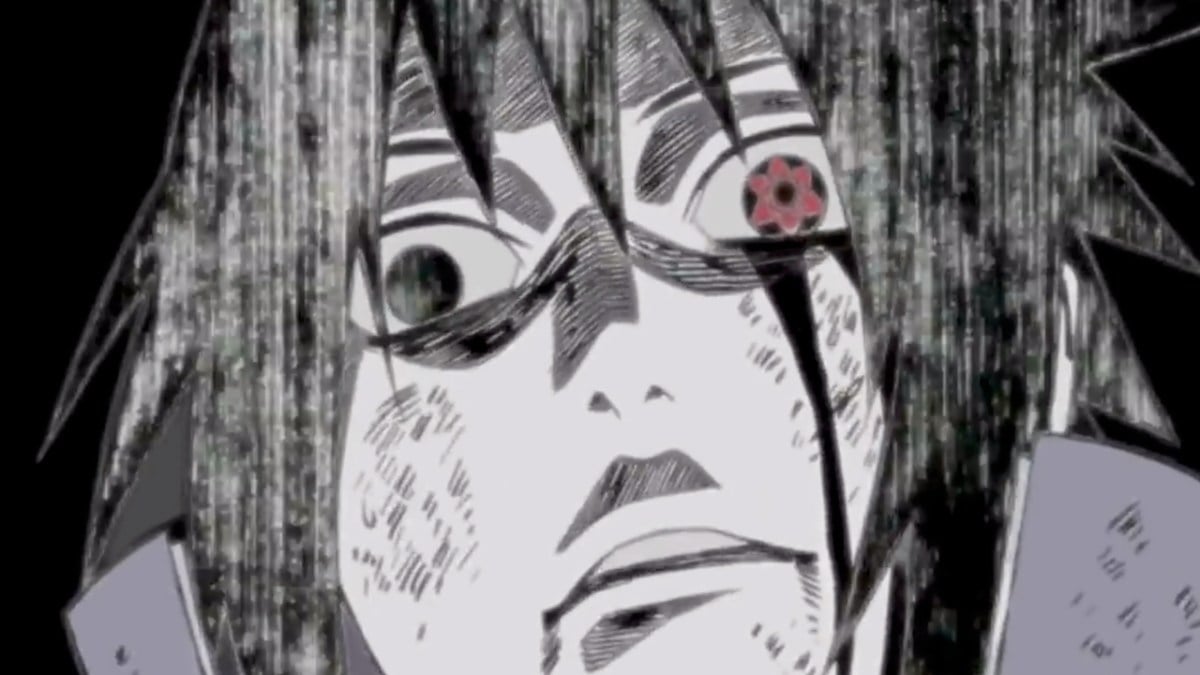
The Sharingan is the hereditary dōjutsu of the Uchiha clan, acting as a biological marvel that awakens and evolves through intense emotional stimuli. Often translated as the Copy Wheel Eye, this ocular power progresses from a basic three-tomoe form to the reality-warping Mangekyō Sharingan, the Eternal Mangekyō Sharingan, and eventually the Rinnegan. Driven by cognitive and neural shifts, the Sharingan’s evolution plays a central role in both the original series and the sequel, Boruto: Two Blue Vortex. This audit resolves production retcons, timeline discrepancies, and transmedia gaps within the franchise.
How Does the Sharingan Awaken and Evolve?
The Sharingan activates selectively when an Uchiha clan member experiences a profound emotional surge, such as extreme grief, trauma, or a powerful desire to protect a loved one. This psychological trigger causes the brain to release a unique form of chakra that travels directly to the optic nerves, transforming the eyes and manifesting the signature red iris with black tomoe. Non-Uchiha can obtain the eye through surgical transplantation, though they suffer severe chakra drain because they cannot deactivate the dōjutsu at will.
The baseline Sharingan matures through three sequential phases, each providing a significant boost to a shinobi’s combat efficacy:
- One Tomoe (The Eye of Insight): Grants basic perception, allowing the wielder to track high-speed movements, detect irregular chakra flows, and see through rudimentary illusions.
- Two Tomoe (The Copy Phase): Enables the user to instantly memorize and replicate physical movements, taijutsu styles, and non-hereditary ninjutsu hand signs.
- Three Tomoe (The Predictive Eye): Represents the fully matured base Sharingan. The user can predict an opponent’s physical trajectory by reading subtle muscle tension and access the Eye of Hypnotism to cast genjutsu via direct eye contact.
Beyond the matured three-tomoe form lies the Mangekyō Sharingan, an advanced stage triggered by the extreme trauma of losing a close companion. It grants unique dōjutsu techniques to each eye, though prolonged usage places severe strain on the wielder’s optic nerves, eventually resulting in permanent blindness. This degeneration can only be halted by transplanting the Mangekyō Sharingan of a close relative – ideally a sibling – to awaken the Eternal Mangekyō Sharingan, stabilizing the visual patterns and eliminating the risk of blindness.
The narrative timeskip commenced with the serialization of Boruto: Two Blue Vortex on August 21, 2023, while several crucial ocular milestones occurred before and during this production transition:
| Publication / Event | Official Release Date (JST) | Primary Narrative / Production Significance |
|---|---|---|
| NNG Chapter 80 | April 20, 2023 | Sarada Uchiha awakens the Mangekyō Sharingan via positive emotional trauma (love and the desire to protect Boruto). |
| TBV Chapter 11 | June 21, 2024 | Introduces the rescue mission in the Land of Wind; establishes the combat stakes for Team Konohamaru against the humanoid Divine Trees. |
| TBV Chapter 12 | July 20, 2024 | Depicts the initial skirmish against Hidari; Sarada relies on base Lightning Release (Chidori Stream) rather than her Mangekyō Sharingan. |
| TBV Chapter 13 | August 21, 2024 | Flashback chapter detailing Boruto’s training under Kashin Koji in an Orochimaru hideout. |
| TBV Chapter 20 | March 19, 2025 | Sarada Uchiha deploys her Mangekyō Sharingan in combat for the first time, reversing the Iron Sand construct manipulated by the Divine Tree clone Ryu. |
| TBV Chapter 21 | April 21, 2025 | Formally titles the chapter “Mangekyō Sharingan” and provides the official name and mechanical limits of Sarada’s primary ability, Ōhirume. |
What Are the Mechanics of Sarada Uchiha’s Mangekyō Sharingan?
A common misconception in the franchise community is that Sarada Uchiha awakened her Mangekyō Sharingan during the three-year timeskip of Boruto: Two Blue Vortex. Official publication records clarify that the awakening occurred in Chapter 80 of the first part, Boruto: Naruto Next Generations, which was published on April 20, 2023. Unlike her predecessors, Sarada awakened her Mangekyō through a surge of positive emotion – specifically, her deep love and desire to protect Boruto – rather than the traditional trigger of hatred or grief. This divergence demonstrates that Uchiha can bypass the historical Curse of Hatred while still unlocking peak ocular power.
Her primary Mangekyō ability, named Ōhirume, is classified as a high-level Ninjutsu rather than a space-time technique like Kamui. Operating on precise gravitational vectoring, Ōhirume allows Sarada to manifest up to four black spheres in her direct field of vision, with sizes ranging from 5 to 250 centimeters. These spheres exert an immense gravitational pull disproportionate to their physical mass, allowing Sarada to isolate and immobilize targets.
When targeting a living organism, the gravitational pull applies symmetrically to both the target and Sarada. To counteract this feedback loop, Sarada must maneuver the remaining spheres to balance the opposing gravitational vectors acting on her body. The net force acting on her during this process is represented by the summation of the gravitational vectors of the active spheres and the natural planetary gravity vector:
F(net) = Sum of F(i), for i = 1 to n, + F(gravity) = m x a
To achieve perfect levitation and high-speed flight (a = 0), she must dynamically regulate her chakra output to the spheres so that:
Sum of F(i), for i = 1 to n, = -F(gravity)
By balancing these forces, Sarada can levitate and fly at high speeds, mimicking the specialized movements of the Ōtsutsuki clan. Additionally, she can command the spheres to detonate as concentrated gravitational bombs. However, Ōhirume consumes an overwhelming amount of chakra, and repeated usage causes her eyesight to deteriorate rapidly toward total blindness. The specific ability of her left eye remains officially unconfirmed.
Who Is Hikari Uchiha and What Are Her Game-Exclusive Abilities?
Introduced in the video game Naruto x Boruto: Ultimate Ninja Storm Connections, released on November 17, 2023, Hikari Uchiha, originally known as Nanashi, is a popular, non-canon character who possessed a highly destructive Mangekyō Sharingan. Rather than being a descendant of Madara Uchiha, official game lore profiles identify her as a child supersoldier from the Warring States era who was sealed in battle by the Sarutobi clan after being exploited as a weapon by her own family.
Hikari’s signature dōjutsu is Yachihoko, a powerful genjutsu that operates in tandem with her Engraved Tsukuyomi. By reflecting the light of her Mangekyō Sharingan off the surface of the moon, Hikari could place a physical branding blemish on anyone caught in the light. This brand allowed her to connect to the victims’ minds and chakra networks on a global scale. Through Yachihoko, she could erase memories, turn targets into mindless puppets, and freely drain or transfer their chakra. Despite fan theories suggesting her ability possessed temporal capabilities, game documentation confirms it is strictly a chakra-linking and cognitive-control technique. Her story remains entirely self-contained within the game’s Special Story mode.
What Are the Differences Between Official Manga Canon and Anime Filler?
Discrepancies often emerge between the original manga canon and the anime adaptations produced by Studio Pierrot. Many secondary sources claim that the Sage of Six Paths, Hagoromo Ōtsutsuki, once possessed a standard Sharingan that evolved into a Mangekyō Sharingan after the death of his love interest, Haori. However, this entire sequence is anime-exclusive filler from episodes that don’t appear anywhere in the manga’s actual chapter sequence. In the manga canon, Hagoromo was born with the Rinnegan as a direct genetic inheritance and never possessed a Sharingan; his eldest son, Indra, was the first canonical wielder of the Sharingan and the Mangekyō Sharingan.
Similar factual distortions occur regarding Sasuke Uchiha’s left eye. While video games and promotional materials occasionally refer to his eye as a Rinne Sharingan, official databooks classify it strictly as a Rinnegan containing six tomoe. The Rinne Sharingan is a distinct, red dōjutsu exclusive to Kaguya Ōtsutsuki and the Ten-Tails.
| Lore Category | Common Fan Claim | Canonical Correction and Official Documentation |
|---|---|---|
| Hagoromo’s Sharingan | Hagoromo awakened a base Sharingan after the death of Haori. | Non-canon anime filler (Episodes 460 to 462). In the manga, Hagoromo was born with the Rinnegan and never possessed the Sharingan. |
| Sasuke’s Rinnegan | Sasuke’s left eye is officially named a Rinne Sharingan. | Official databooks classify his eye strictly as a six-tomoe Rinnegan. Only Kaguya’s forehead eye is a Rinne Sharingan. |
| Hikari’s Lineage | Hikari Uchiha is the daughter or granddaughter of Madara Uchiha. | Connections database files confirm she was a child soldier from the Warring States period, predating Madara’s generation. |
| Yachihoko Mechanics | Yachihoko allows Hikari to manipulate and rewind time. | Game files clarify Yachihoko is a mind-control and chakra-linking genjutsu; it has no temporal or time-altering capabilities. |
How Did Editorial and Production Choices Shape the Sharingan’s History?
Behind-the-scenes production histories reveal that the conceptualization of the Sharingan and its users was highly collaborative. Masashi Kishimoto’s original character editor, Kosuke Yahagi, heavily influenced the early visual identity of the Uchiha clan. Kishimoto initially designed characters with heavy shadows under their eyes, but Yahagi advised that such shadowing was not shōnen-like. Yahagi also insisted that Naruto Uzumaki required a clear rival, which led directly to the creation of Sasuke Uchiha.
Furthermore, Kishimoto’s peer network played a critical role in shaping Uchiha lore. In official joint interviews, Kishimoto confirmed that Sasuke’s cold personality and visual design were directly inspired by Hiei from Yoshihiro Togashi’s Yu Yu Hakusho, rather than Kurapika from Hunter x Hunter. While fans often assume the red, emotion-activated Sharingan was copied from Hunter x Hunter‘s Scarlet Eyes, Kishimoto’s 1995 one-shot manga, Karakuri, had already established early concepts of special ocular traits years before Togashi’s series began serialization in 1998.
During the production of the original Naruto anime, Studio Pierrot had to execute a major animation correction in Episode 131. In Episode 84, when Sasuke remembers the night of the Uchiha massacre, Itachi casts Tsukuyomi with his eyes remaining in their standard three-tomoe Sharingan form. When this flashback was re-animated for Episode 131, Itachi’s eyes were corrected to transform into his unique pinwheel Mangekyō pattern. This correction was necessary because Kishimoto had not yet finalized or published the physical design of the Mangekyō Sharingan when Episode 84 was produced.
In the modern serialization of Boruto: Two Blue Vortex, the creative division of labor has shifted. At the Konoha Experience event in Paris in August 2024, Kishimoto and Mikio Ikemoto clarified that Boruto is entirely Ikemoto’s manga. While Kishimoto provides basic story outlines and approves chapter drafts, Ikemoto writes the script and designs the characters, emphasizing a modern fashion aesthetic. This artistic shift is highly visible in Sarada’s design and the mechanical nature of her gravity-based Ōhirume ability, and it mirrors how to watch the entire Naruto franchise in the order that actually makes narrative sense for viewers trying to track that evolution across eras.










Updated: Jul 14, 2026 03:07 pm