


I’m going to start this review by ripping off the band-aid. If you didn’t like the first Death Stranding, you’re unlikely to enjoy Death Stranding 2: On the Beach.
Got it? Good.
Death Stranding 2 starts eleven months after the original ended. Sam and Lou are living off-grid when Sam is convinced to do one last job for his friend, Fragile. In classic video game fashion, a personal tragedy turns that job into an epic quest to expand the chiral network.
You’ll notice that that short section is light on details about the story. Really, this is a game that’s best experienced blind. What I will say is that the storyline may well be an improvement on the original. The emotional beats are as strong as ever, the narrative is intricate, and the quirky cast of characters are delightful. Old favorites like Fragile and Deadman are back, and newcomers like Rainy and Tomorrow fit right in with the crew.
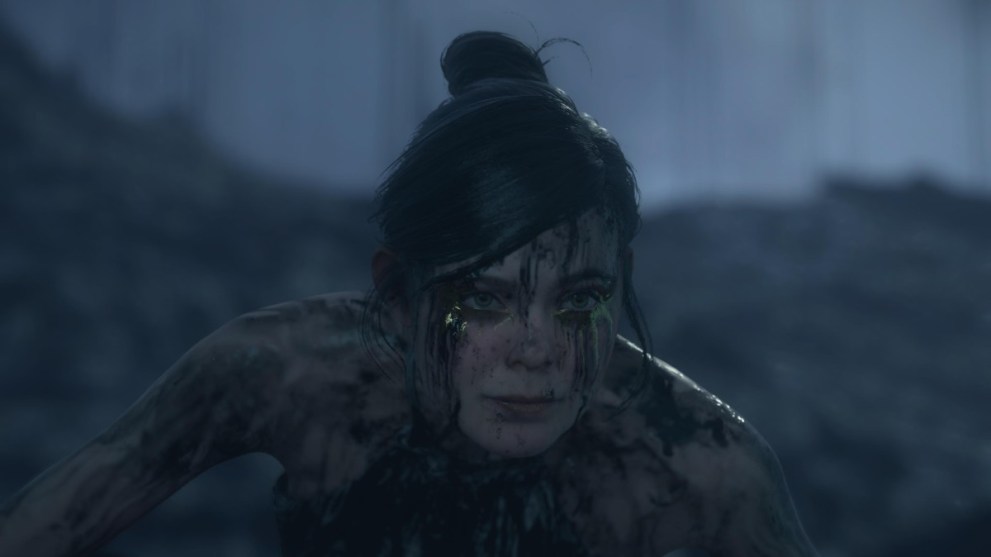
Even the minor characters largely come across as likable. The preppers you’ll meet on your journey all have distinct personalities, and you’ll want to keep bringing them deliveries, both to max out their bonds and take advantage of the upgrades they offer. Whether it’s new weapons or new skeletons, you’ll want to keep as many satisfied as possible.
Which brings me to the core gameplay loop. As in Death Stranding, you’ll be tasked with delivering cargo from shelter to shelter. Like the original, the soundtrack really gives things a triumphant feel, so even walking feels epic. The environment is more diverse than the original, so it feels like you’re exploring a new biome every few hours.
Outside of the story, there’s a wonderfully meditative quality to this aspect. You may well take a few hours just driving through a small section of the map dropping off cargo. However, this does lead to the odd moment of frustration where you can’t seem to max out a shelter’s bond.
Of course, there’s plenty of action. You have more options to take on your foes than in Death Stranding, whether that’s stealth or combat. There are some new weapons this time around, including a ludicrously fun boomerang, so combat is never a chore. Shooting someone with a bola gun, then decking them, somehow feels fresh even after 40 hours.

Of course, it isn’t just enemies – the environment itself is a hazard. There are frequent gate quakes, sandstorms, whiteouts, flash floods, and even wildfires, so you’ll often need to reevaluate your plans on the go. Part of the joy of the game is making a difficult journey, but it’s always worth planning carefully to avoid the all-too-common occurrence of taking the path less travelled and damaging some precious cargo, only to find a relatively easy path to your starting point. I’ve never felt quite as ashamed in a game as I did when I put a ladder up on what turned out to be a wall I could easily have walked around.
Despite the new hazards, the map is somewhat easier to navigate, especially when you link new areas to the network. It feels like you’re always making progress, but it’s always worth taking your time to make future journeys quicker. There’s one particular mountain range you’ll spend hours navigating, but a few ziplines will make it far easier.
Graphically, the game is gorgeous and takes full advantage of the PS5’s capabilities. The environments are more varied than in Death Stranding, and the character models are beautiful. Of course, saying that a Hideo Kojima game is beautiful is par for the course. There were a few glitches (a zipline that travelled through solid rock, some clipping here and there), but nothing extreme enough to ruin the experience.
However, that does bring me to a problem all too familiar with Hideo Kojima fans: it’s complicated. For roughly the first 90% of the game, things are fine, but it does eventually reach the point where you’ll hear a knock on the door, and suddenly the story has advanced several insane beats. It makes sense in that dream logic way, but it’s also the sort of game that requires dedication and attention. There are also a few loose ends and red herrings that feel a little anticlimactic.
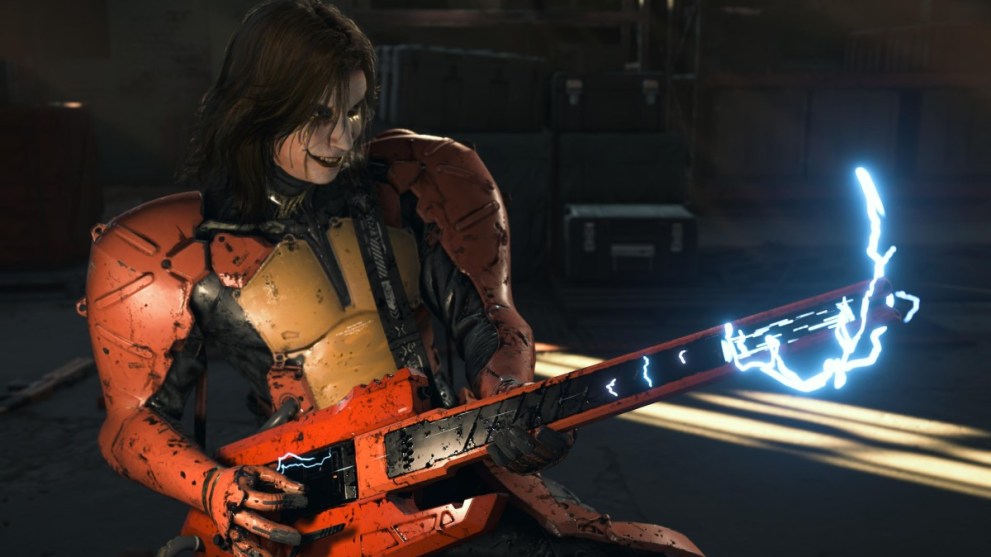
However, I never found myself questioning the strength of Sam’s relationships; crucial, in a game ultimately about those bonds. Some of the weirder moments still feel thematically right, but could have benefited from a bit more explanation.
I was also disappointed that the point of no return wasn’t as clearly signposted as it could have been. It’s not the end of the world, but it did mean waiting to complete a few sidequests, or even fully link up the map, until after I’d seen the end credits roll.
There’s also a strange lack of consistency. Cargo can be fine if you crash into a tree, but not if you crash into a much smaller rock. As in Death Stranding, the map is truly massive, but since things aren’t separated into different zones this time (for the most part), it does feel disconnected. The lack of loading screens means that the game treats a distance of some 2500 miles as something that can be traversed in half an hour with the right zipline set up. Simultaneously, there’s a huge distance between settlements in theory, and yet when you’re charting your course, it’s a mere few hundred metres. It’s a small gripe, and an acceptable break from reality, but it does make the expansive (and, again, gorgeous) open world feel, paradoxically, small.
None of this is enough to ruin the game. It’s not perfect, by any means, but if you liked the original, there’s a lot more of what you love here. If you didn’t like the original, though, Death Stranding 2 isn’t likely to change your mind.
- Streamlined gameplay
- Engaging storyline and characters
- Gorgeous design
- An oddly disconnected map
- Occasional visual glitches
- Poor signposting


Updated: Jun 26, 2025 10:45 am